Author: Monita Buchwald

Thomas Nozkowski: Colorful and Intimate Abstract Art


Thomas Nozkowski, Untitled (9-32), oil on linen panel

Thomas Nozkowski, Untitled (9-32), oil on linen panel

I was recently struck by a Matisse-like painting used to promote a new exhibition at the The Pace Gallery. It turned out to be by American born Thomas Nozkowski. Since the 1970’s, Nozkowski has produced abstract paintings and drawings in which he experiments with a form, color, or gesture, and then reworks it repeatedly over time. My response to Nozokowski’s painting was well-founded. In a recent interview with Artspace, Nozkowski commented:

“There’s a painting in this show with some Matissean curvy shapes painted in a Matisse blue—that’s not an accident, it was a decision to draw upon that blue for that particular move.”

More than 60 paintings and drawings, most of them created in the last year, are on view at the gallery. One of the interesting aspects of Nozkowski’s art is the fact that he works on 16 x 20 inch canvases. In his Artspace interview he explained why he chose that size:

“…I decided I would paint at a size that was scaled to my friends’ apartments, that could hang in a three-room walkup tenement on 7thStreet. …Once I made that decision I discovered how easy it was to put an idea in the world, look at it, and then wipe it off and do something else if it’s no good. Suddenly, I could go through hundreds of ideas in the life of a painting. When I did large paintings like I did in art school, it could take days to change a color.”
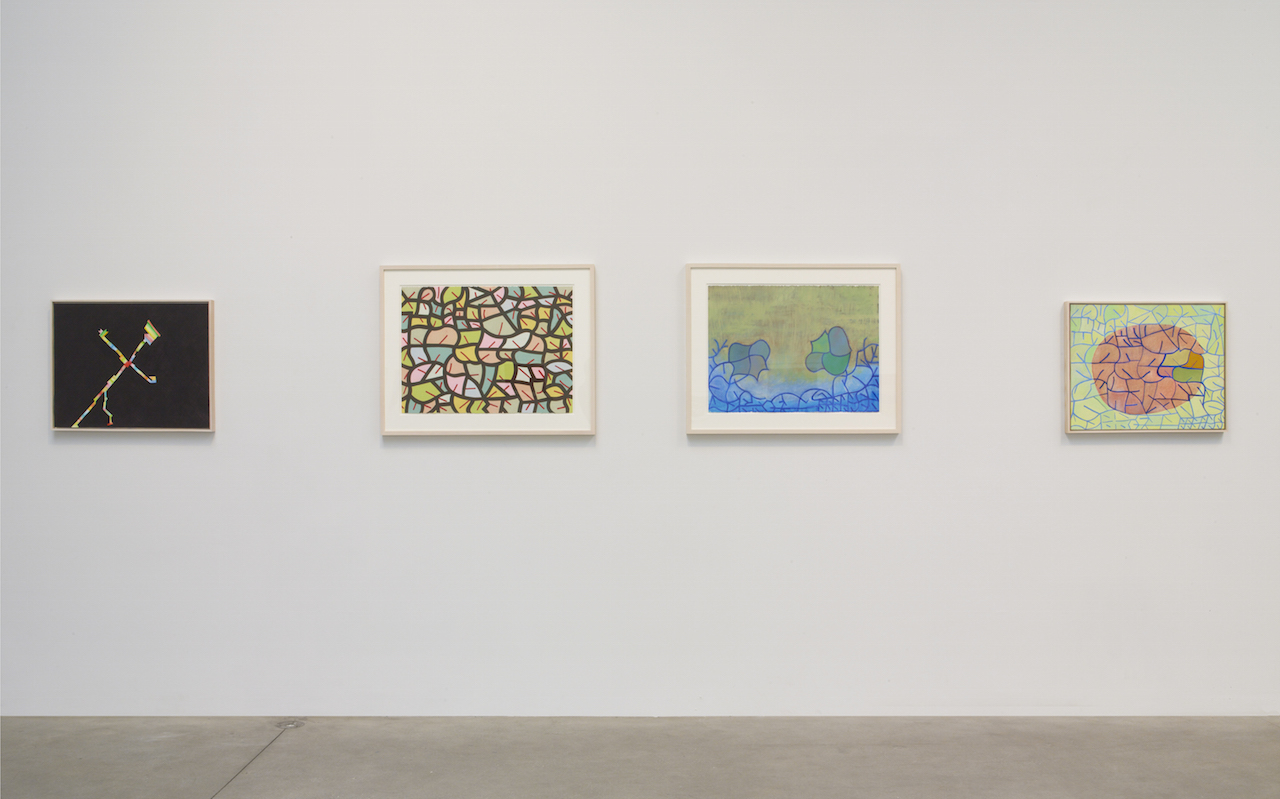
Installation View, "Thomas Nozkowski" Pace Gallery

Installation View, “Thomas Nozkowski” Pace Gallery

The exhibit will be on view through April 25th. If you are going down to Chelsea, be sure to also see:

“Alice Neel Drawings and Watercolors 1927-1978 at David Zwirner, 537 West 20th Street, on view through 4/18.

In the Studio: Paintings” at Gagosian, 522 West 21st, on view through  4/18.

Roz Chast: Drawings, Textiles and Dyed Eggs

Roz Chast Library Cover, published Oct. 18, 2010 watercolor and ink on paper 10 x 8 inches
Roz Chast
Library Cover, published Oct. 18, 2010
watercolor and ink on paper
10 x 8 inches

If you read the  New Yorker then you know the wit and wisdom of Roz Chast’s wonderful cartoons.  Something More Pleasant, at the Danese/Corey Gallery, gives you an opportunity to see Chast’s work up close, and appreciate them not only for their humor but also for their artistry.

The exhibition is a mix of Chast’s cartoons and New Yorker covers, as well as textiles and pysanka (dyed eggs) created with the same humor and flair.

This slideshow requires JavaScript.

The show will be on view through April 18th. And, if you are a fan of Roz Chast, you can see more of her work at the Norman Rockwell Museum (Stockbridge, MA) this summer.

Spring Art Events in NYC


There’s always new art to see in New York City. It’s good to plan ahead so you don’t miss out. This spring there are some great shows opening at the major museums: the 2015 Costume Institute extravaganza at the Metropolitan Museum of Art, “China Through the Looking Glass,” opening May 7th; Basquiat: The Unknown Notebooks at the Brooklyn Museum opening April 3rd;or Yoko Ono: One Woman Show, 1960–1971 at MoMA, opening May 17th. And then, there’s the re-opening of the Whitney on May 1st in it’s new location on Gansevoort Street, off the Highline.

But there are also exciting art events and openings happening where you may not be looking. For example:

Russian Modernism: Cross-Currents in German and Russian Art, 1907-1917 , Neue Galerie, 5/14-8/31

The Hirschfeld Century: The Art of Al Hirschfeld at the New York Historical Society, 5/22-10/12

Life Lines: Portrait Drawing from Dürer to Picasso at the Morgan Library and Museum, 6/12 – 9/8

Two art fairs that are worth checking out are:

Spring Masters New York at the Park Ave Armory, 5/8-12 – the fair will feature leading international galleries from the U.S. and Europe, exhibiting art and design from antiquity through the 21st century.

Frieze New York Art Fair, Randall’s Island  5/14-17 -Frieze New York is one of the few fairs to focus on contemporary art and living artists. The exhibiting galleries represent  artists working today from around the globe.


Tatiana Trouvé’s “Desire Lines” in Central Park

"Desire Lines" Tatiana Trouvé, Central Park

“Desire Lines” Tatiana Trouvé, Central Park

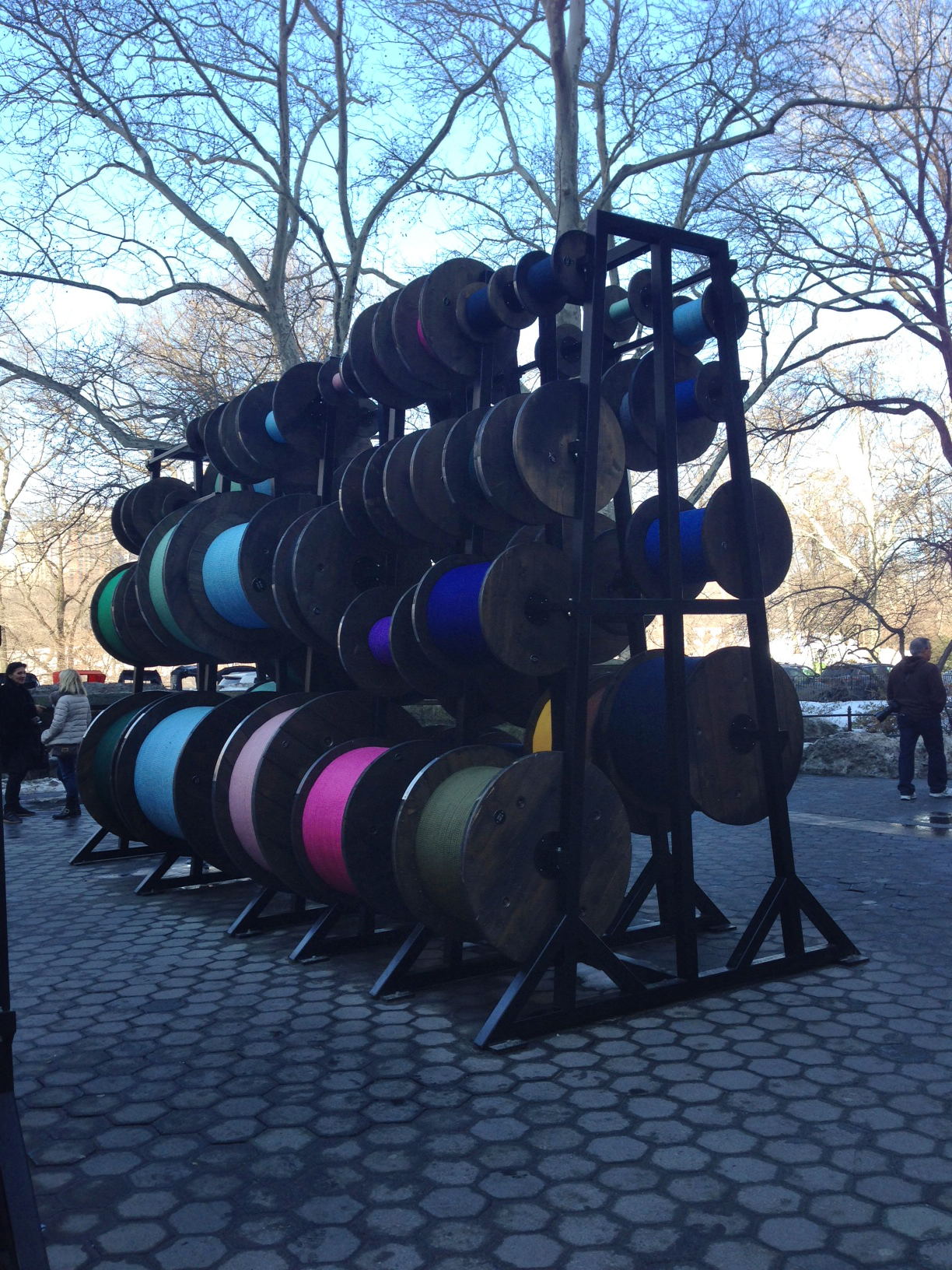
With spring finally in the air, take advantage of the warmer weather and go see “Desire Lines,” a fun and creative outdoor installation by Parisian sculptor, Tatiana Trouvé. It  is composed of miles of colored rope wound around huge wooden spools that hold them. Commissioned by the Public Art Fund, Trouvé’s work is an homage to Central Park. If unwound, the “threads” would stretch along every inch of the 212 paths that snake through the park’s 843-acre rectangle. Many of the paths are unnamed, so Trouvé  invented an “atlas” of the history and culture of walking.


Visitors to Desire Lines can choose a path by name then undertake the walk it describes. I went to visit the piece on a frosty day, when snow was still piled around the edges of the park. Without any visible signage, it was hard to appreciate just what you were seeing. Fortunately, I had a chance to visit the Park Avenue Gagosian Gallery which has a companion exhibit called, “Tatiana Trouvé: Studies for Desire Lines.

At the gallery you can see  sculptures, drawings, and preparatory studies that Trouvé  used for Desire Lines. In addition to vellum tracings and cast part-objects, there are detailed graphite drawings inlaid with copper and vertical maps of Central Park in raw canvas with paths hand-stitched in colored silks.

Tatiana Trouvé at the Gagosian gallery

Tatiana Trouvé at the Gagosian gallery

You can see the sculpture at the Doris C. Freedman Plaza near 60th Street and Fifth Avenue until August 3oth. “Studies for Desire Lines” will be on view until April 25th.

In The Studio: Two Exhibits at Gagosian


“In The Studio” is a pair of exhibitions, at different Gagosian galleries, that focus on images of artists’ studios. The exhibit in Chelsea,“In the Studio: Paintings,” was curated by John Elderfield, Chief Curator Emeritus of Painting and Sculpture at The Museum of Modern Art.

The works span from the mid-sixteenth through the late twentieth centuries. There are over 50 paintings and works on paper by nearly 40 artists including: Georges Braque, Helen Frankenthaler, Alberto Giacometti, Jasper Johns, Henri Matisse, Robert Motherwell, Pablo Picasso, Robert Rauschenberg, and  Diego Rivera. Seeing this art in the gallery setting was a particularly thrilling experience. It was interesting to see the diversity of approaches to a common subject from such influential artists. And the gallery setting provided a much more intimate engagement with the pieces then one would have had in a museum.

The second exhibit, “In the Studio: Photographs,” is on view at the Gagosian Madison Avenue gallery. It includes over 150 photographs, spanning from the beginnings of photography to the late twentieth century.  Forty artists are represented, including: Richard Avedon, Walker Evans  Lee Friedlander, Lucas Samaras and Cindy Sherman. It was curated by Peter Galassi, former Chief Curator of Photography at The Museum of Modern. While I enjoyed the paintings more, the photographs on view are intriguing because of the unique approaches taken by the artists.

Both shows closed April 18th.

Toulouse-Lautrec at MOMA

Henri de Toulouse-Lautrec (French, 1864–1901). Jane Avril. 1899. Lithograph, sheet: 22 1/16 x 15″

Henri de Toulouse-Lautrec (French, 1864–1901). Jane Avril. 1899. Lithograph, sheet: 22 1/16 x 15″

If you went to MoMA in the past few months, it was probably to see the Matisse Cut-Outs exhibit which recently closed. But there’s reason to return soon, and that’s to see “The Paris of Toulouse-Lautrec:Prints and Posters.” The exhibition is drawn almost exclusively from MoMA’s posters, lithographs, printed ephemera, and illustrated books by Lautrec.  It features over 100 examples of the best-known works created during the peak of his career.

 The exhibition is organized around five subjects that create a portrait of Lautrec’s Paris. One section is devoted to café-concerts and dance halls, including  the Moulin Rouge. Another group focuses on the actresses, singers, dancers, and performers who “sparked the artist’s imagination and served as his muses,” according to the exhibition notes.  There’s also a series of prints and posters focusing on prostitutes in their non-working hours. A fourth section is centered on Lautrec’s role in the Parisian artistic community. A final grouping shows Lautrec’s depictions of popular Parisian activities like horse racing at Longchamp and promenading on the Bois de Boulogne.

I was quite familiar with Lautrec’s dance hall posters but found that the simple lines of some of the lesser known works, really drew me in. The exhibit is on view through March 22nd.

From Hebrew Illumination to Contemporary Drawings: Two Exciting Exhibits at the Morgan

What I love about visiting The Morgan Library & Museum are their diverse exhibits and the inviting space within which to experience them. Two newly opened exhibits drew me there recently.

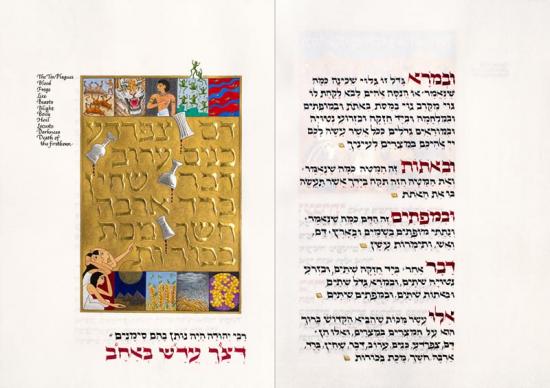
The Ten Plagues, Barbara Wolff The Rose Haggadah 2011–13

The Ten Plagues, Barbara Wolff
The Rose Haggadah
2011–13

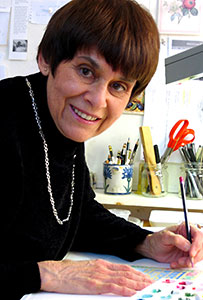
The first was “Hebrew Illumination for Our Time: The Art of Barbara Wolff,” (on view until May 3). Wolff is a contemporary artist who uses the techniques of medieval manuscript illumination. She paints on animal skin, and highlights her illustrations with silver, gold, and platinum foils.  The  manuscript, the traditional book that accompanies the Passover Seder, was originally commissioned for use by the Rose family.  The Hebrew text was written by Izzy Pludwinski , and the English captions are by Karen Gorst.

Barbara Wolff

Barbara Wolff

In addition to having each page of the Haggadah on view, there is a fascinating film that accompanies the exhibit. An Illuminated Haggadah for the 21st Century  documents the process and craft involved in creating the Rose Haggadah. Wolf describes everything from what kind of animal skin she selects and why; her formula for creating gesso (the binder applied as a basis for the gold leaf); and the ancient art that inspires her illustrations.

The exhibit also showcases ten folios of “You Renew the Face of the Earth”  which Wolff created to illustrate passages from Hebrew Psalm 104, a celebration of all creation.

This slideshow requires JavaScript.

For a completely different kind of art, also go see Embracing Modernism: Ten Years of Drawings Acquisitions. There are over eighty drawings from 1900-2013, acquired by the Morgan over the past decade. They include an exciting group of artists from Matisse, Mondrian and Schiele to Pollack, Warhol and Lichentstein.  Curator Isabelle Dervaux has organized the drawings “by the characteristics that define its modernity in relation to the historical tradition. ”  The themes are: The Autonomy of the Line; Gesture and Trace; High and Low; Everyday Objects; and From Melancholia to Schizophrenia. This exhibit is on view until May 24th.

Romare Bearden Exhibit and Other Art at Columbia University

Romare Beardon, "Poseiden. The Sea God-Enemy of Odysseus" (1977);  collage of various papers, with foil, paint, ink and graphite on fiberboard)

Romare Beardon, “Poseiden. The Sea God-Enemy of Odysseus” (1977); collage of various papers, with foil, paint, ink and graphite on fiberboard

“Romare Bearden: A Black Odyssey” is an exciting new exhibit on view at the Wallach Art Gallery at Columbia University. Based on Homer’s poem, Bearden created a series of collages and watercolors that bring to life Odysseus’s battles, triumphs, temptations and sacrifices that he experienced in his 10-year journey home to Ithaca.

Bearden’s interpretations “bridge classical mythology and African American culture,” notes the exhibition catalog. “Bearden saw Harlem in Homer’s Odyssey, and Odysseus in Harlem.”

Matisse illustration from 1935 edition of  James Joyce's Ulysses

Matisse illustration from 1935 edition of James Joyce’s Ulysses

Also on view at the exhibit is a 1935 special edition of James Joyce’s Ulysses from Columbia’s Rare Book and Manuscript Library. The book contains reproductions of 20 preliminary drawings and six etchings by Henri Matisse, who based his illustrations on six episodes in Homer’s Odyssey. This was particularly interesting to see following on the heels of the MoMA “Matisse Cutouts” exhibit which closed recently. Watching Bearden create his collages in a film available at the exhibit is reminiscent of a similar film shown at the “Cutouts” exhibition; both artists drawing with scissors.


This slideshow requires JavaScript.

The Wallach Art Gallery is just one location at Columbia University to see art work. It’s also worth visiting Columbia University for  the wide range of sculptures situated throughout the Morningside campus, including works by Auguste Rodin, Daniel Chester French, and Henry Moore. The outdoor sculptures are part of approximately 10,000 works of art, overseen by Columbia’s Art Properties department. Donated to the University over the past two centuries, the art can be found in public spaces and also held in storage. They include:

  • Nearly 2,000 paintings, including hundreds of portraits of Columbia administrators and faculty since the eighteenth century, and the largest repository of paintings by Florine Stettheimer (1871-1944)
  • About 900 works of fine art photography from daguerreotypes to Andy Warhol polaroids
  • The Sackler Collection of over 2,000 Asian art works, including Buddhist sculpture in stone, bronze, and polychrome wood from India, China, and Japan
  • Hundreds of works on paper (drawings, watercolors, prints) and decorative arts (ceramics, tapestries, furniture) from around the globe

Roberto C. Ferrari, an art historian and librarian, was hired in 2013 as curator of Art Properties. He and his team are developing an online inventory and exploring social media options to make more of the collection digitally accessible not only to the Columbia community, but to art lovers worldwide.

For now, be sure to visit the “Romare Bearden: A Black Odyssey” which will be on view through March 14th. Then, when the weather warms up, stroll through the campus to see the collection of outdoor sculptures.

Marisol’s “Self-Portrait Looking at The Last Supper”

marisol

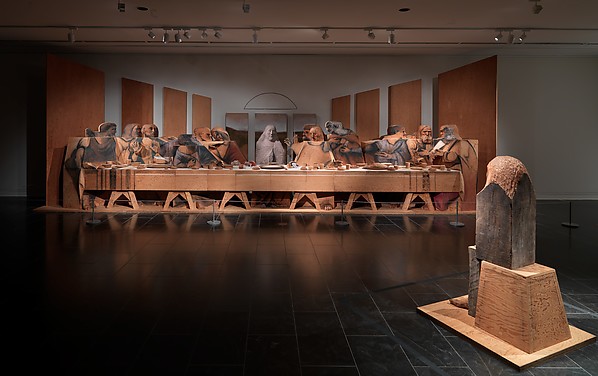
Though I’m at the Metropolitan Museum of Art every week, I somehow missed seeing an incredible sculptural installation by the artist, Marisol.  She is best known for her large figural sculptures, which address a variety of subjects. The piece at the Met is entitled, “Self Portrait Looking at the Last Supper,” and is based on Leonardo Da Vinci’s painting of the same name. At 30-feet long, it is the same length as Da Vinci’s fresco.

Seated across the room from The Last Supper, there is a single wooden figure representing the artist herself . Her presence is meant to underscore that art is about looking, evaluating, and reinventing what one sees, according to the exhibition notes.

You can find “Self Portrait Looking at the Last Supper” all on it’s own in gallery 909 in the first floor Modern and Contemporary Paintings section. Exhibiting it this way allows the viewer to really appreciate the details of the construction and feel the impact of the piece.

“Self Portrait Looking at the Last Supper” was supposed to close several weeks ago but will be on view at least through March. It’s worth a visit to the Met just to see it but certainly stop by if you’re at the Met for other reasons.


Art in the Comfort of Your Home

Don’t let the predicted NYC “Blizzard 2015” deter you from seeing art. Most museums now have their collections online and with the Google Art Project you can view collections from around the world; create your own personalized gallery; or find artists that you like.

There are also a variety of films and talks you can watch that provide an in-depth look at an artist — their work and their process. Here are some to consider that I’ve really enjoyed.

Movies 

Chuck Close: A Portrait in Progress (You Tube) — documentary that explores Close’s inspiring life story while showcasing his creative and exciting portraits.

Gerhard Richter Painting (Netflix streaming) —  Richter’s creative process juxtaposed with intimate conversations and rare archival material. You can watch Richter create a series of large-scale abstract canvasses, using fat brushes and a large squeegee to apply (and then scrape off) layer after layer of paint.

Waste Land: Vik Muniz (DVD) — Filmed at the world’s largest garbage dump, Jardim Gramacho, located on the outskirts of Rio de Janeiro. Muniz  photographs a group of “catadores”—self-designated pickers of recyclable materials. Muniz’s initial objective was to “paint” the catadores with garbage. In the end, he partners with them to recreate photographic images of themselves out of the collected garbage.

David Hockney: A Bigger Picture (Amazon Prime Instant Video) — Filmed over 3 years it captures David Hockney’s return from California to his native Yorkshire. H is shown painting outside through the seasons and in all weathers.

Ai Wewei: Never Sorry  (Netflix streaming)– a portrait of China’s most famous international artist, and its most outspoken domestic critic.  Ai expresses himself and organizes people through art and social media. The movie shows his work and how the Chinese authorities have shut down his blog, beat him up, bulldozed his newly built studio, and held him in secret detention.

NYC-Arts

NYC-ARTS is a program which airs weekly on a local PBS station — Channel 13 or 21 — but can be viewed online as well. Many of the programs focus on exhibits at local museums and feature talks by curators. A recent program featured Paula Zahn in conversation with Emily Braun and Rebecca Rabinow, the curators of the exhibition “Cubism: The Leonard A. Lauder Collection,” which is on view at The Metropolitan Museum of Art.

TED Talks

TED is a nonprofit organization devoted to spreading ideas, usually in the form of short, talks (18 minutes or less). TED began in 1984 as a conference where Technology, Entertainment and Design converged, and today covers almost all topics — from science to business to global issues — in more than 100 languages.  You can search “art” topics on the TED Talks website and find a wide range of talks. I especially enjoyed “Art with wire, sugar, chocolate and string,” a talk by Brazilian artist, Vik Muniz.

Do you have a favorite movie, program or talk about or with an artist? Share the link and I’ll add it to the list.