exhibit

Tatiana Trouvé’s “Desire Lines” in Central Park

"Desire Lines" Tatiana Trouvé, Central Park

“Desire Lines” Tatiana Trouvé, Central Park

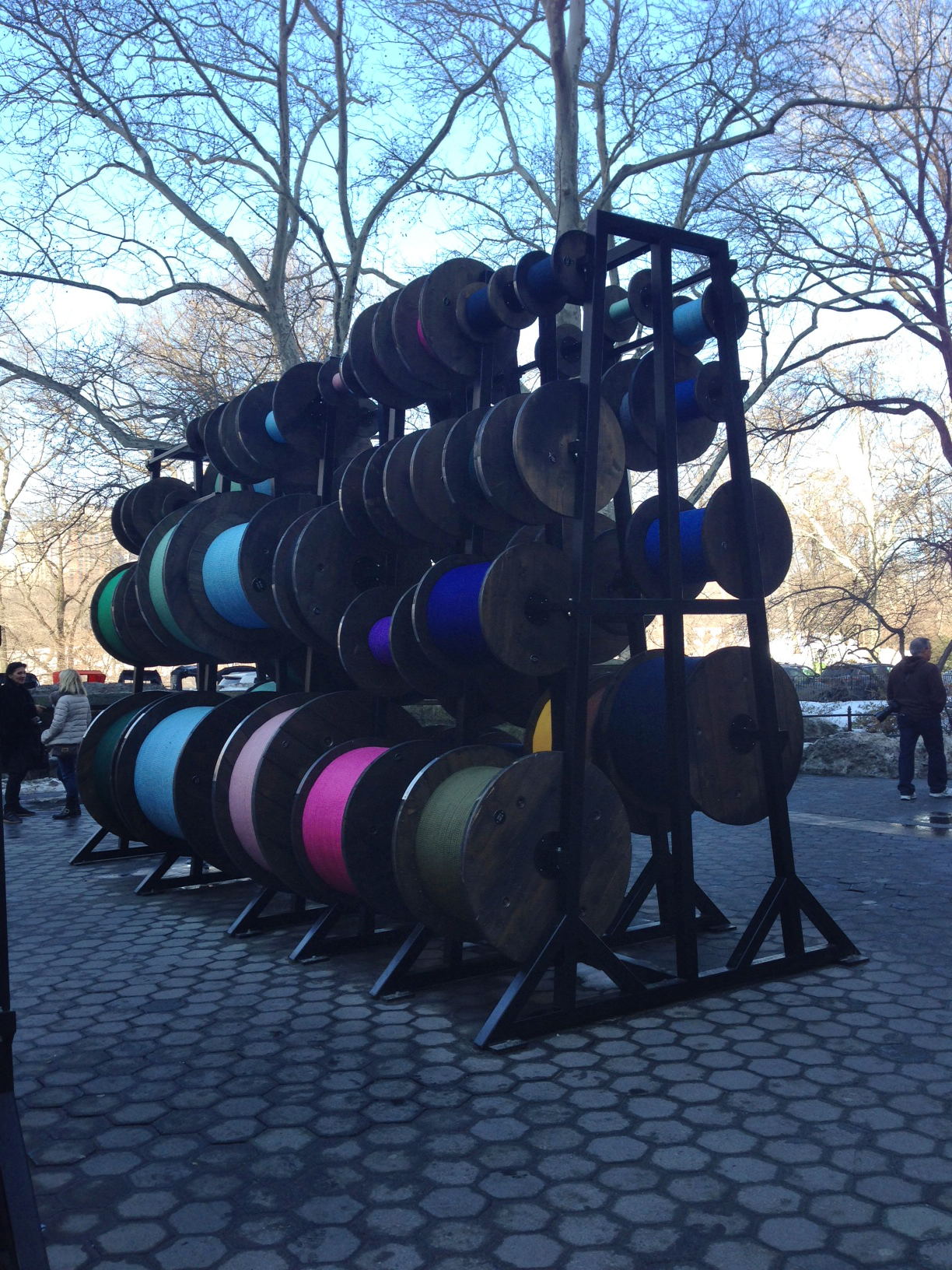
With spring finally in the air, take advantage of the warmer weather and go see “Desire Lines,” a fun and creative outdoor installation by Parisian sculptor, Tatiana Trouvé. It  is composed of miles of colored rope wound around huge wooden spools that hold them. Commissioned by the Public Art Fund, Trouvé’s work is an homage to Central Park. If unwound, the “threads” would stretch along every inch of the 212 paths that snake through the park’s 843-acre rectangle. Many of the paths are unnamed, so Trouvé  invented an “atlas” of the history and culture of walking.


Visitors to Desire Lines can choose a path by name then undertake the walk it describes. I went to visit the piece on a frosty day, when snow was still piled around the edges of the park. Without any visible signage, it was hard to appreciate just what you were seeing. Fortunately, I had a chance to visit the Park Avenue Gagosian Gallery which has a companion exhibit called, “Tatiana Trouvé: Studies for Desire Lines.

At the gallery you can see  sculptures, drawings, and preparatory studies that Trouvé  used for Desire Lines. In addition to vellum tracings and cast part-objects, there are detailed graphite drawings inlaid with copper and vertical maps of Central Park in raw canvas with paths hand-stitched in colored silks.
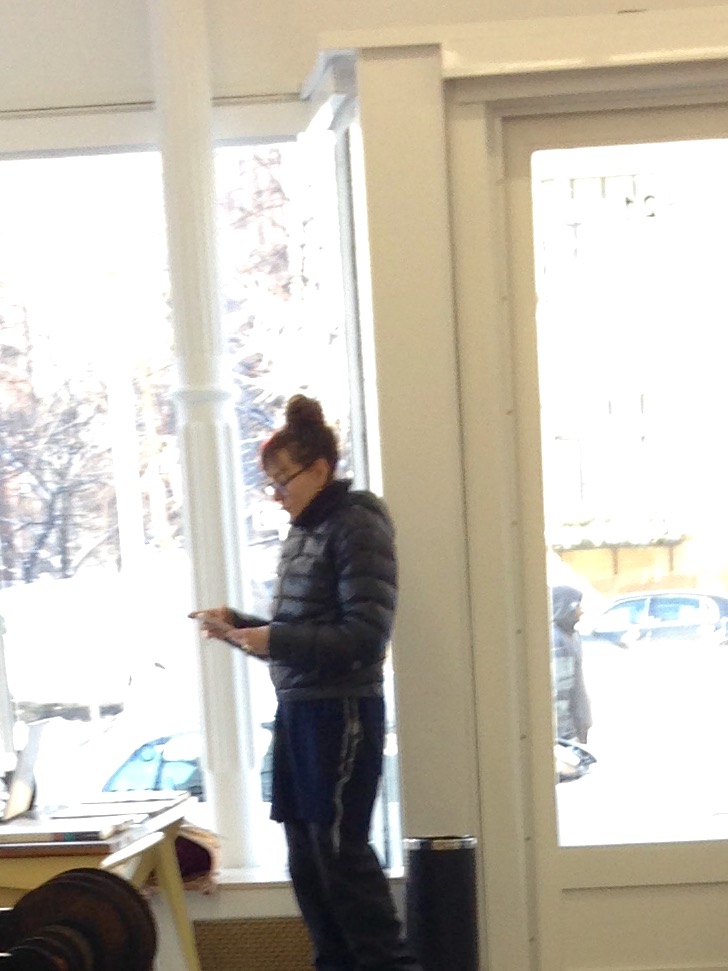
Tatiana Trouvé at the Gagosian gallery

Tatiana Trouvé at the Gagosian gallery

You can see the sculpture at the Doris C. Freedman Plaza near 60th Street and Fifth Avenue until August 3oth. “Studies for Desire Lines” will be on view until April 25th.

Toulouse-Lautrec at MOMA

Henri de Toulouse-Lautrec (French, 1864–1901). Jane Avril. 1899. Lithograph, sheet: 22 1/16 x 15″

Henri de Toulouse-Lautrec (French, 1864–1901). Jane Avril. 1899. Lithograph, sheet: 22 1/16 x 15″

If you went to MoMA in the past few months, it was probably to see the Matisse Cut-Outs exhibit which recently closed. But there’s reason to return soon, and that’s to see “The Paris of Toulouse-Lautrec:Prints and Posters.” The exhibition is drawn almost exclusively from MoMA’s posters, lithographs, printed ephemera, and illustrated books by Lautrec.  It features over 100 examples of the best-known works created during the peak of his career.

 The exhibition is organized around five subjects that create a portrait of Lautrec’s Paris. One section is devoted to café-concerts and dance halls, including  the Moulin Rouge. Another group focuses on the actresses, singers, dancers, and performers who “sparked the artist’s imagination and served as his muses,” according to the exhibition notes.  There’s also a series of prints and posters focusing on prostitutes in their non-working hours. A fourth section is centered on Lautrec’s role in the Parisian artistic community. A final grouping shows Lautrec’s depictions of popular Parisian activities like horse racing at Longchamp and promenading on the Bois de Boulogne.

I was quite familiar with Lautrec’s dance hall posters but found that the simple lines of some of the lesser known works, really drew me in. The exhibit is on view through March 22nd.

From Hebrew Illumination to Contemporary Drawings: Two Exciting Exhibits at the Morgan

What I love about visiting The Morgan Library & Museum are their diverse exhibits and the inviting space within which to experience them. Two newly opened exhibits drew me there recently.

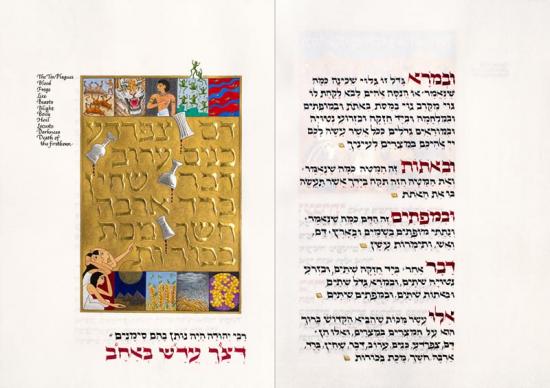
The Ten Plagues, Barbara Wolff The Rose Haggadah 2011–13

The Ten Plagues, Barbara Wolff
The Rose Haggadah
2011–13

The first was “Hebrew Illumination for Our Time: The Art of Barbara Wolff,” (on view until May 3). Wolff is a contemporary artist who uses the techniques of medieval manuscript illumination. She paints on animal skin, and highlights her illustrations with silver, gold, and platinum foils.  The  manuscript, the traditional book that accompanies the Passover Seder, was originally commissioned for use by the Rose family.  The Hebrew text was written by Izzy Pludwinski , and the English captions are by Karen Gorst.

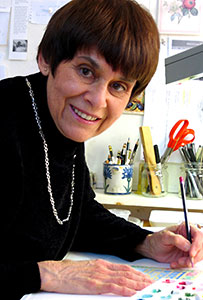
Barbara Wolff

Barbara Wolff

In addition to having each page of the Haggadah on view, there is a fascinating film that accompanies the exhibit. An Illuminated Haggadah for the 21st Century  documents the process and craft involved in creating the Rose Haggadah. Wolf describes everything from what kind of animal skin she selects and why; her formula for creating gesso (the binder applied as a basis for the gold leaf); and the ancient art that inspires her illustrations.

The exhibit also showcases ten folios of “You Renew the Face of the Earth”  which Wolff created to illustrate passages from Hebrew Psalm 104, a celebration of all creation.

This slideshow requires JavaScript.

For a completely different kind of art, also go see Embracing Modernism: Ten Years of Drawings Acquisitions. There are over eighty drawings from 1900-2013, acquired by the Morgan over the past decade. They include an exciting group of artists from Matisse, Mondrian and Schiele to Pollack, Warhol and Lichentstein.  Curator Isabelle Dervaux has organized the drawings “by the characteristics that define its modernity in relation to the historical tradition. ”  The themes are: The Autonomy of the Line; Gesture and Trace; High and Low; Everyday Objects; and From Melancholia to Schizophrenia. This exhibit is on view until May 24th.

Romare Bearden Exhibit and Other Art at Columbia University

Romare Beardon, "Poseiden. The Sea God-Enemy of Odysseus" (1977);  collage of various papers, with foil, paint, ink and graphite on fiberboard)

Romare Beardon, “Poseiden. The Sea God-Enemy of Odysseus” (1977); collage of various papers, with foil, paint, ink and graphite on fiberboard

“Romare Bearden: A Black Odyssey” is an exciting new exhibit on view at the Wallach Art Gallery at Columbia University. Based on Homer’s poem, Bearden created a series of collages and watercolors that bring to life Odysseus’s battles, triumphs, temptations and sacrifices that he experienced in his 10-year journey home to Ithaca.

Bearden’s interpretations “bridge classical mythology and African American culture,” notes the exhibition catalog. “Bearden saw Harlem in Homer’s Odyssey, and Odysseus in Harlem.”

Matisse illustration from 1935 edition of  James Joyce's Ulysses

Matisse illustration from 1935 edition of James Joyce’s Ulysses

Also on view at the exhibit is a 1935 special edition of James Joyce’s Ulysses from Columbia’s Rare Book and Manuscript Library. The book contains reproductions of 20 preliminary drawings and six etchings by Henri Matisse, who based his illustrations on six episodes in Homer’s Odyssey. This was particularly interesting to see following on the heels of the MoMA “Matisse Cutouts” exhibit which closed recently. Watching Bearden create his collages in a film available at the exhibit is reminiscent of a similar film shown at the “Cutouts” exhibition; both artists drawing with scissors.


This slideshow requires JavaScript.

The Wallach Art Gallery is just one location at Columbia University to see art work. It’s also worth visiting Columbia University for  the wide range of sculptures situated throughout the Morningside campus, including works by Auguste Rodin, Daniel Chester French, and Henry Moore. The outdoor sculptures are part of approximately 10,000 works of art, overseen by Columbia’s Art Properties department. Donated to the University over the past two centuries, the art can be found in public spaces and also held in storage. They include:

  • Nearly 2,000 paintings, including hundreds of portraits of Columbia administrators and faculty since the eighteenth century, and the largest repository of paintings by Florine Stettheimer (1871-1944)
  • About 900 works of fine art photography from daguerreotypes to Andy Warhol polaroids
  • The Sackler Collection of over 2,000 Asian art works, including Buddhist sculpture in stone, bronze, and polychrome wood from India, China, and Japan
  • Hundreds of works on paper (drawings, watercolors, prints) and decorative arts (ceramics, tapestries, furniture) from around the globe

Roberto C. Ferrari, an art historian and librarian, was hired in 2013 as curator of Art Properties. He and his team are developing an online inventory and exploring social media options to make more of the collection digitally accessible not only to the Columbia community, but to art lovers worldwide.

For now, be sure to visit the “Romare Bearden: A Black Odyssey” which will be on view through March 14th. Then, when the weather warms up, stroll through the campus to see the collection of outdoor sculptures.

Being There Without Being There: Art Exhibitions on Screen

If you live in New York, then you should go see the Matisse Cut-Outs at MoMA. But if you can’t make it to the museum, you can go to the movies to see it, and four other exciting exhibits from museums around the world.

Fathom Events, in association with Arts Alliance and Seventh Art Productions, is bringing five art exhibitions to select U.S. cinemas with “Exhibitions on Screen.”   The first film, “Matisse from MoMA and Tate Modern,” begins on January 13th and is playing locally at Union Square Stadium 14, Empire 25, and Kips Bay 15. The other four exhibitions to be screened are:

Rembrandt from the National Gallery London & Rijksmuseum Amsterdam

Vincent van Gogh – A New Way of Seeing from the Van Gogh Museum in Amsterdam

Girl with a Pearl Earring and Other Treasures from the Mauritshuis in the Hague

The Impressionists from the Musée de Luxembourg Paris, National Gallery London, and the Philadelphia Museum of Art

(Thanks RDK for the heads-up)


Textile Exhibition: The Consequences of Hate Speech (Lashon Hara)

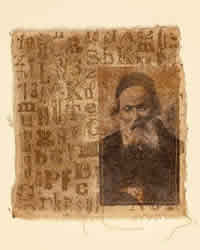
Chofetz Chaim, Robin Atlas, 2012

Chofetz Chaim, Robin Atlas, 2012

Lashon Hara: On the Consequences of Hate Speech is an unusual art exhibition at the Anne Frank Center in lower Manhattan. Hebrew for “evil speech,” Lashon Hara focuses on how words can be used to destroy and are at the root of intolerance, anti-semitism, racism and discrimination.


At the "Lashon Hara" exhibit, Anne Frank Center

At the “Lashon Hara” exhibit, Anne Frank Center

Set within a permanent exhibit on Anne Frank, Lashon Hara features a collection of mixed media works, by textile artist Robin Atlas . “It is intended to stimulate awareness of the impact of our words. It is my hope that from that, diverse factions become the whole and a common good evolves,” says Atlas. Each piece references an aspect of Jewish law about “evil speech,” or a tale from Jewish folklore. I wish the lighting had been better because the pieces were each very beautiful but they were hard to see. The exhibition, presented in conjunction with the Jewish Art Salon, will be on view through February 27th.

The Power of Style: Verdura At 75

This slideshow requires JavaScript.

An iconic cuff worn by Coco Chanel; a curb link watch synonymous with Greta Garbo; and gold cigarette cases commemorating every musical  composed by Cole Porter, are just a few of the unique  items you will see at “The Power of Style: Verdura At 75.” This year is the 75th anniversary of Duke Fulco di Verdura opening his doors on Fifth Avenue.  Verdura, the jewelry company that carries his name, is celebrating with a museum worthy exhibit.

Duke Fulco di Verdura with Coco Chanel

Duke Fulco di Verdura with Coco Chanel

Duke Fulco di Verdura began his career working with Coco Chanel in Paris where he created her signature Maltese Cross cuffs. In 1934, Verdura came to the United States, creating  jewels for Hollywood stars, and the wealthy of American and European societies. In 1939, Verdura opened his store on Fifth Avenue in New York with the financial backing of Cole Porter and Vincent Astor. He was not trained as either a jeweler or an artist but his creations belie this reality. The exhibition  features a selection of more than 150 of  Verdura’s original jewels and objets d’art. There is also a small selection of his 10,000 gouache jewelry designs, archival materials, his personal miniature paintings, and  period photographs. You can hear Verdura talk about his work and inspirations in a rare interview he did with WOR Radio.


Ward Landrigan, Chairman & CEO and Nico Landrigan, President

Ward Landrigan, Chairman & CEO and Nico Landrigan, President

What made the visit to the exhibit extraordinary was being given a tour by Chairman and CEO Ward Landrigan. He purchased the company in 1984, six years after Verdura’s death. Mr. Landrigan has said, “it’s been my dream to share Verdura’s genius with a wider audience and bring him the recognition he deserves as the single most influential jeweler of the 20th Century. I want people to know this amazing man, who he was and why his work changed everything.” Landrigan’s passion for Verdura is clear as he shares his personal experiences and tells the stories behind every piece in the exhibition

The exhibit was curated by Carolina and Reinoldo Herrera, and Patricia Lansing. It will be on view until December 23rd. Though it’s free, you will need timed tickets to attend. Be sure to take the guided tour too.

Unexpected Art at the Mid-Manhattan Library

outside

Heading west on 41st — my destination Fifth Avenue — I was struck by the beautiful paintings I saw in the windows of the Mid-Manhattan Library. As I walked on, I learned that these paintings were part of an exhibition: Peter Bynum:Illuminated Paint, The Interconnectedness of All Life. This exhibit is one in a series by the Mid-Manhattan Library called, “What Inspires Artists.”

This slideshow requires JavaScript.

Bynum creates three-dimensional illuminated paintings on glass. At the exhibition I learned that he “opens new territory for painting by exposing paint’s intrinsic branching behavior, and then illuminating the complex nervous system it creates.” What was especially interesting was that, “Bynum devised an innovative method of pressuring paint between panes of tempered glass, which he then layers through a precise bracketing system, and backlights with LED-powered screens.” As a viewer, you see these spidery and colorful paintings that seem to be moving.

The artwork will be on display until January 25th 2015. On Tuesday, October 7th at 6:30pm, there will be a discussion between the painter and senior art librarian Arezoo Moseni about Bynum’s illuminated paintings.

Hockney at Pace Gallery

This slideshow requires JavaScript.

Contemplative yet joyful, The Arrival of Spring is a new exhibit at the Pace Gallery on West 25th Street which features recent prints, drawings and videos by David Hockney. All the art work in the exhibition was inspired by the gradual change from winter to spring in Woldgate, East Yorkshire. Hockney spent two summers there as a teenager, working on a farm nearby. He returned to Yorkshire in 1999, after years of living in Los Angeles.

This slideshow requires JavaScript.

The first rooms you enter at the Pace gallery are filled with charcoal drawings Hockney did in Woldgate between January and May 2013. “They are five separate views of Woldgate, and with each one I had to wait for the changes to happen. Some were too close to the previous ones and I realised I was being impatient. I had to wait for bigger change. I thought it was an exciting thing to do. It made me look harder at what I was drawing,” noted Hockney in his artist statement.

This slideshow requires JavaScript.

What I found truly spectacular were the works Hockney created on his iPad. Each work, bursting with color, depicts a specific day between January 1 and May 231st 2011. While the charcoal drawings are very detailed with fine lines, with the iPad drawings Hockney took a different approach. “These were drawn knowing they would be printed a certain size. The mark making is very varied for this reason.”

The exhibit will be on view until November 1st. Don’t miss it.

Enduring Brilliance! 42nd Annual Pastel Society of America Exhibition

home

Enduring Brilliance! is the premier event for pastel artists in this country and abroad. It is sponsored by the Pastel Society of America and on exhibit in the National Arts Club’s historic mansion along Gramercy Park. Marjorie Shelly, a distinguished authority on pastels and the Sherman Fairfield conservator in charge, Sherman Fairfield Center for Works on Paper and Photography Conservation, Metropolitan Museum of Art, will jury the selected finalists and choose the recipients of $25,000 to $30,000 in cash and material awards.

This slideshow requires JavaScript.


There are 182 pastels on display selected from 1,222 entries. I was really taken by the diverse ways the artists used pastel. There are still lives, landscapes, portraits, and abstract pieces. There were some pieces that were so realistic that they looked like photographs.

This slideshow requires JavaScript.

In other pieces, you could more easily see the mark of the pastel chalk. Among my favorites was “Bouquet,” by Deborah Stewart, because of its vibrant colors. Also, “Shaving Brush,” by Maceo W. Mitchell, Director of Education at PSA (and a wonderful teacher). It reminded me of paintings by Wayne Thiebaud.

The exhibit, which is free, runs from September 2nd-27th. You can visit M, W, Thu and Fri 10am-12pm and 2-5pm; Tues 3-5pm and Sat-Sun. 10am-5pm. The address is 15 Gramercy Park South (20th Street between Park Avenue South and Irving Place).

Monita Buchwald, "Still life, July 2014"

Monita Buchwald, “Still life, July 2014”