Art

2015 Museum Mile Festival

museummille_logo_37

This year’s Museum Mile Festival takes place on Tuesday, June 9th from 6-9:00pm. Nine museums from 82nd -105th Street are open late and free to the public. Fifth Avenue will closed to traffic; there’s street entertainment; and it’s a great opportunity to get a taste of art from different institutions. But beware – there can be long lines to get into some of the museums.
Thomas Hart Benton, City Activities With Dancehall

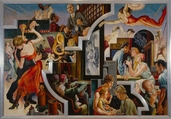
Thomas Hart Benton, City Activities With Dancehall

One of the most popular museums on Museum Mile is the Metropolitan Museum of Art. I’d recommend entering the museum at the 81st Street entrance — where school groups are directed — it will probably be less crowded. Only part of the museum will be open that night; primarily the new big exhibits like China Through the Looking Glass. These will be pretty crowded so if you can, seek out some smaller exhibits or work from the permanent collection. For example, the Met just reinstalled the ten-panel mural,  America Today, by Thomas Hart Benton.  Benton  painted this mural for New York’s New School for Social Research to hang in the school’s boardroom. It  depicts a sweeping panorama of American life throughout the 1920s. It was on view as a special exhibition but now is permanently installed in gallery 909 in the Modern Wing of the museum.


Making Design, Cooper-Hewitt museum

Making Design, Cooper-Hewitt museum

It’s also a good night to visit a museum that you don’t normally go to. Try Cooper-Hewitt Museum  which wasn’t open when last year’s Museum Mile event took place. One current exhibition to see is  Making Design. It’s the first in a number of exhibitions devoted to showcasing Cooper Hewitt’s extensive collection. It brings together some 360 objects, including furniture, lighting fixtures, tableware, clothing, jewelry, books, and posters, providing an overview of five key elements of design: line, form, texture, pattern, and color (red, for this initial installation).

Picasso:Femmes

picasso1

Pablo Picasso on view at David Benrimon Fine Art LLC

I just returned from Barcelona where, among many art museums, I visited The Museu Picasso.  Its focus is on Picasso’s formative years and is home to  4,251 works that make up their permanent collection. The museum also has special exhibitions. I saw a wonderful one looking at the relationship between Picasso and Salvador Dali.

When I returned, I was delighted to learn that David Benrimon Fine Art LLC had a Picasso exhibition highlighting and celebrating some of the women who  inspired Picasso’s life’s work. While Picasso had relationships with many women, there were eight, according to the gallery, who had a critical influence on his work: Fernande Olivier, Eva Gouel, Gaby Lespinasse, Olga Khokhlova, Marie- Thérèse, Dora Maar, Françoise Gilot and Jacqueline Roque.  Picasso: Femmes includes portraits such as the 1936 painting of Marie-Thérèse, as a young adolescent. There are three different portrayals of Jacqueline; his muse and second wife for the last nineteen years of his life.

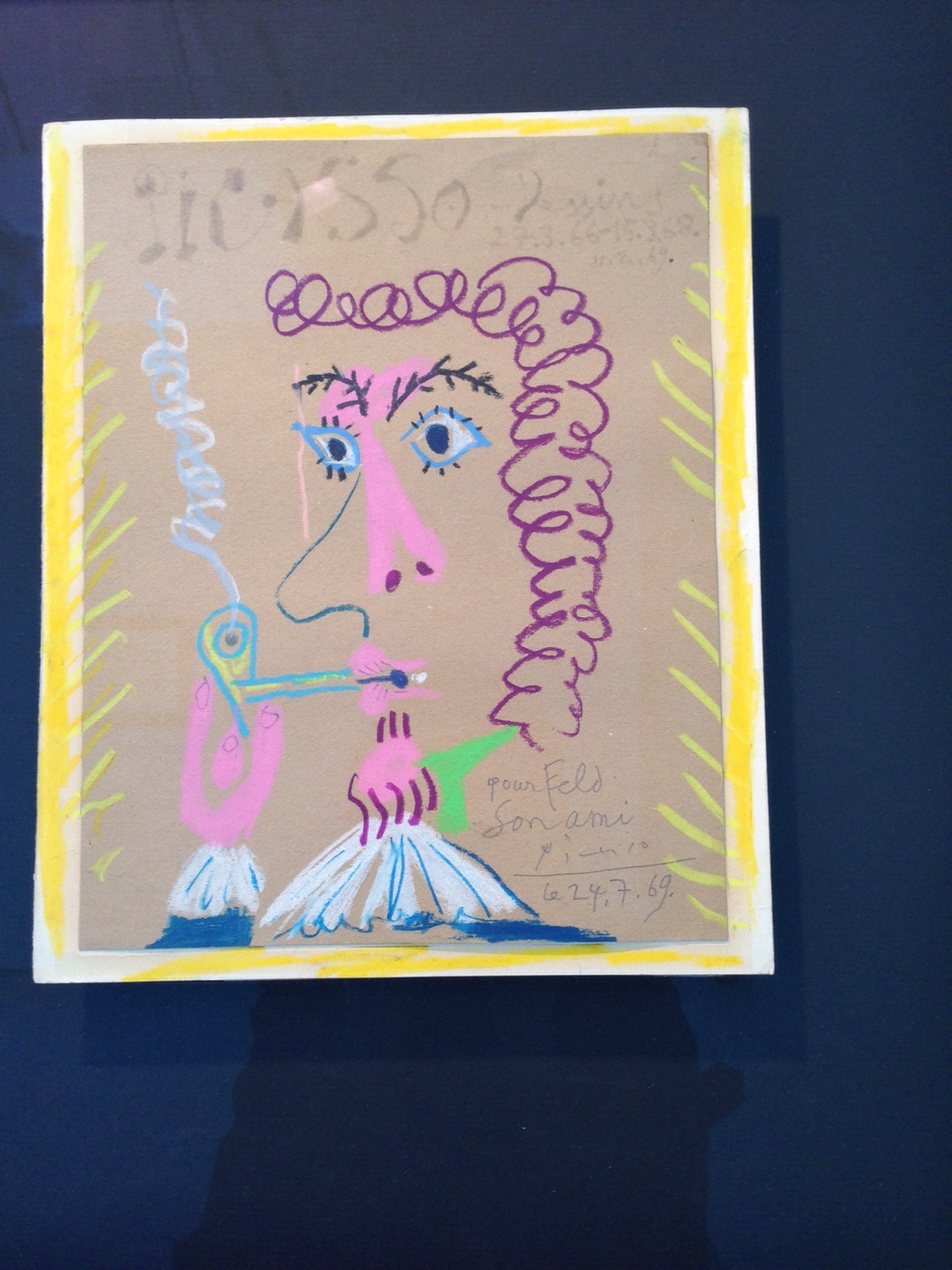
Pablo Picasso, Fumeur, 1969, Crayon and felt tip pen on brown paper mounted on paper

Pablo Picasso, Fumeur, 1969, Crayon and felt tip pen on brown paper mounted on paper

There are also several works on paper and a number of portraits Picasso did using “aquatint,”a process of etching tonal values, which can create a look like ink or watercolor washes. One amusing piece was not within the “femmes” theme but part of a series of portraits Picasso did of smokers. This crayon and felt tip pen portrait looked like something a school child would draw. Nonetheless, it had a distinct Picasso feel to it. If you’re a Picasso fan then this is a show worth visiting. It will be on view through June 30th at the gallery in the Crown Building (730 Fifth).

Pablo Picasso, Stage Curtain for the Ballet "Le Tricorne," 1919

Pablo Picasso, Stage Curtain for the Ballet “Le Tricorne,” 1919

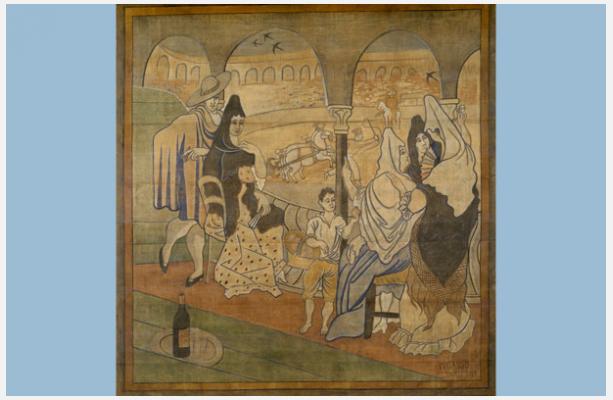
You might also want to stop by the New York Historical Society to see the newly acquired, and conserved, stage curtain, “Le Tricorne.”   For more than half a century it has hung in the hallway of the Four Seasons Restaurant, in the landmarked Seagram Building. Picasso painted the curtain for the two-act ballet The Three-Cornered Hat (El sombrero de tres picos or Le tricorne). The ballet and curtain were commissioned by Sergei Diaghilev for his Paris-based Ballets Russes. It opens May 29th and wil be on permanent view at NYHS.

The Drawing Center: Contemporary and Historical Art in SoHO

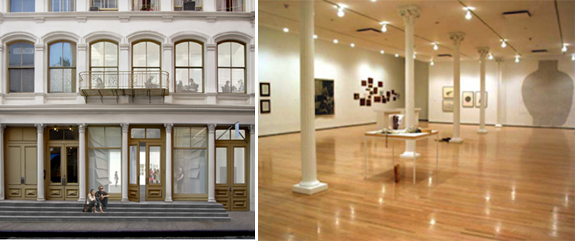
Facade_Home_MAIN1Located at the southern end of SoHo, The Drawing Center is a non-profit gallery/museum devoted to the medium of drawing — both historical and contemporary.  Since its founding in 1977, The Drawing Center has spotlighted drawing connected with science, literature, architecture and political movements. There are also lectures, gallery talks, family workshops and literary programs that enhance the exhibitions. Like the Chelsea galleries, The Drawing Center gives you an opportunity to see the work from both new artists and older masters in an intimate setting.

There are two very different shows on view at The Drawing Center right now — both worth visiting. In the main gallery is “Portraits from the École des Beaux-Arts Paris.” The exhibition explores four hundred years of portrait drawings, emphasizing work from live models. Forty portraits have been chosen from the Beaux-Arts de Paris’ collection based on “diverse criteria such as the male and female gestures, caricature, frontal gaze, social class, and profession of the model.” The portraits range from seventeenth-century to the present and include never-before-exhibited drawings by nineteenth-century artists Jean-Auguste-Dominique Ingres and Charles Garnier to the work of modern and contemporary artists like Henri Matisse and Georg Baselitz.

In the lower level gallery is a completely different kind of drawing exhibit – “Natalie Frank: The Brothers Grimm.”  Frank, a 35-year-old, contemporary artist, has brought to life the “unsanitized” versions of the fairy tales of Jacob and Wilhelm Grimm. Using bold colors in gouache and pastel, Frank focuses on the dynamics between flesh and spirit. According to the artist, she is exploring, “the parallel poles of longing and desire but also disgust and fascination that constitute humanity.”  From afar, the scenes are both alluring and grotesque. Up close, you can appreciate the richness in detail and will be drawn in by the energy emanating from the colors.

Both shows will be on view through June 28th.

A Curious Blindness: Artists Responding To Race and Identity Politics

a curious blindness, at Columbia University’s Miriam and Ira D. Wallach Art Gallery, brings together the work of eighteen early- to mid-career artists. The thematic focus is their interpretations  of how people of color are treated and represented in today’s world.  The title of the exhibition,  “a curious blindness,” comes  from the poem, People, by Jean Toomer, a writer from the Harlem Renaissance who struggled with his mixed-race heritage.

One of the first pieces you see when entering the gallery is a giant “whitening” tube next to a small video screen. This is the work of Baltimore artist Nora Howell. In her performance and installation she created a “public intervention that animates her sculptures while drawing attention to her own relationship to whiteness as well as inciting a conversation about whitening as a social contract,” according to the exhibition catalog.

This slideshow requires JavaScript.

Two large galleries and three smaller rooms are populated with videos,  performance art, photography, collage,  paintings and sculpture. The pieces are as different as the artists who created them but are all thought-provoking and engaging.

The exhibit is the the third presentation of MODA Curates. This is an annual opportunity offered by The Wallach Art Gallery and the MA in Modern Art: Critical and Curatorial Studies Program (MODA) for outstanding curatorial proposals related to students’ theses. a curious blindness is curated by Vivian Chui, Tara Kuruvilla, and Doris Zhao and will be on view until June 13.

Thomas Nozkowski: Colorful and Intimate Abstract Art


Thomas Nozkowski, Untitled (9-32), oil on linen panel

Thomas Nozkowski, Untitled (9-32), oil on linen panel

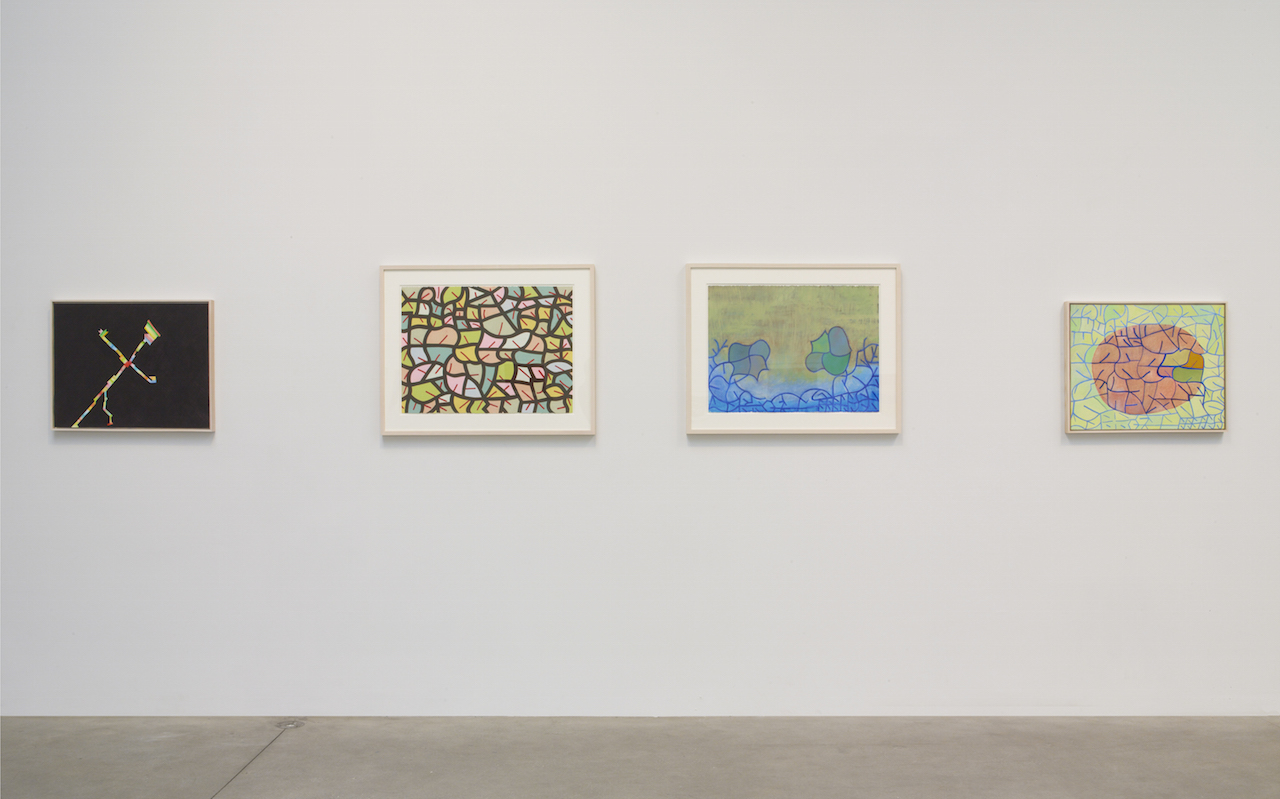
I was recently struck by a Matisse-like painting used to promote a new exhibition at the The Pace Gallery. It turned out to be by American born Thomas Nozkowski. Since the 1970’s, Nozkowski has produced abstract paintings and drawings in which he experiments with a form, color, or gesture, and then reworks it repeatedly over time. My response to Nozokowski’s painting was well-founded. In a recent interview with Artspace, Nozkowski commented:

“There’s a painting in this show with some Matissean curvy shapes painted in a Matisse blue—that’s not an accident, it was a decision to draw upon that blue for that particular move.”

More than 60 paintings and drawings, most of them created in the last year, are on view at the gallery. One of the interesting aspects of Nozkowski’s art is the fact that he works on 16 x 20 inch canvases. In his Artspace interview he explained why he chose that size:

“…I decided I would paint at a size that was scaled to my friends’ apartments, that could hang in a three-room walkup tenement on 7thStreet. …Once I made that decision I discovered how easy it was to put an idea in the world, look at it, and then wipe it off and do something else if it’s no good. Suddenly, I could go through hundreds of ideas in the life of a painting. When I did large paintings like I did in art school, it could take days to change a color.”

Installation View, "Thomas Nozkowski" Pace Gallery

Installation View, “Thomas Nozkowski” Pace Gallery

The exhibit will be on view through April 25th. If you are going down to Chelsea, be sure to also see:

“Alice Neel Drawings and Watercolors 1927-1978 at David Zwirner, 537 West 20th Street, on view through 4/18.

In the Studio: Paintings” at Gagosian, 522 West 21st, on view through  4/18.

Spring Art Events in NYC


There’s always new art to see in New York City. It’s good to plan ahead so you don’t miss out. This spring there are some great shows opening at the major museums: the 2015 Costume Institute extravaganza at the Metropolitan Museum of Art, “China Through the Looking Glass,” opening May 7th; Basquiat: The Unknown Notebooks at the Brooklyn Museum opening April 3rd;or Yoko Ono: One Woman Show, 1960–1971 at MoMA, opening May 17th. And then, there’s the re-opening of the Whitney on May 1st in it’s new location on Gansevoort Street, off the Highline.

But there are also exciting art events and openings happening where you may not be looking. For example:

Russian Modernism: Cross-Currents in German and Russian Art, 1907-1917 , Neue Galerie, 5/14-8/31

The Hirschfeld Century: The Art of Al Hirschfeld at the New York Historical Society, 5/22-10/12

Life Lines: Portrait Drawing from Dürer to Picasso at the Morgan Library and Museum, 6/12 – 9/8

Two art fairs that are worth checking out are:

Spring Masters New York at the Park Ave Armory, 5/8-12 – the fair will feature leading international galleries from the U.S. and Europe, exhibiting art and design from antiquity through the 21st century.

Frieze New York Art Fair, Randall’s Island  5/14-17 -Frieze New York is one of the few fairs to focus on contemporary art and living artists. The exhibiting galleries represent  artists working today from around the globe.


Tatiana Trouvé’s “Desire Lines” in Central Park

"Desire Lines" Tatiana Trouvé, Central Park

“Desire Lines” Tatiana Trouvé, Central Park

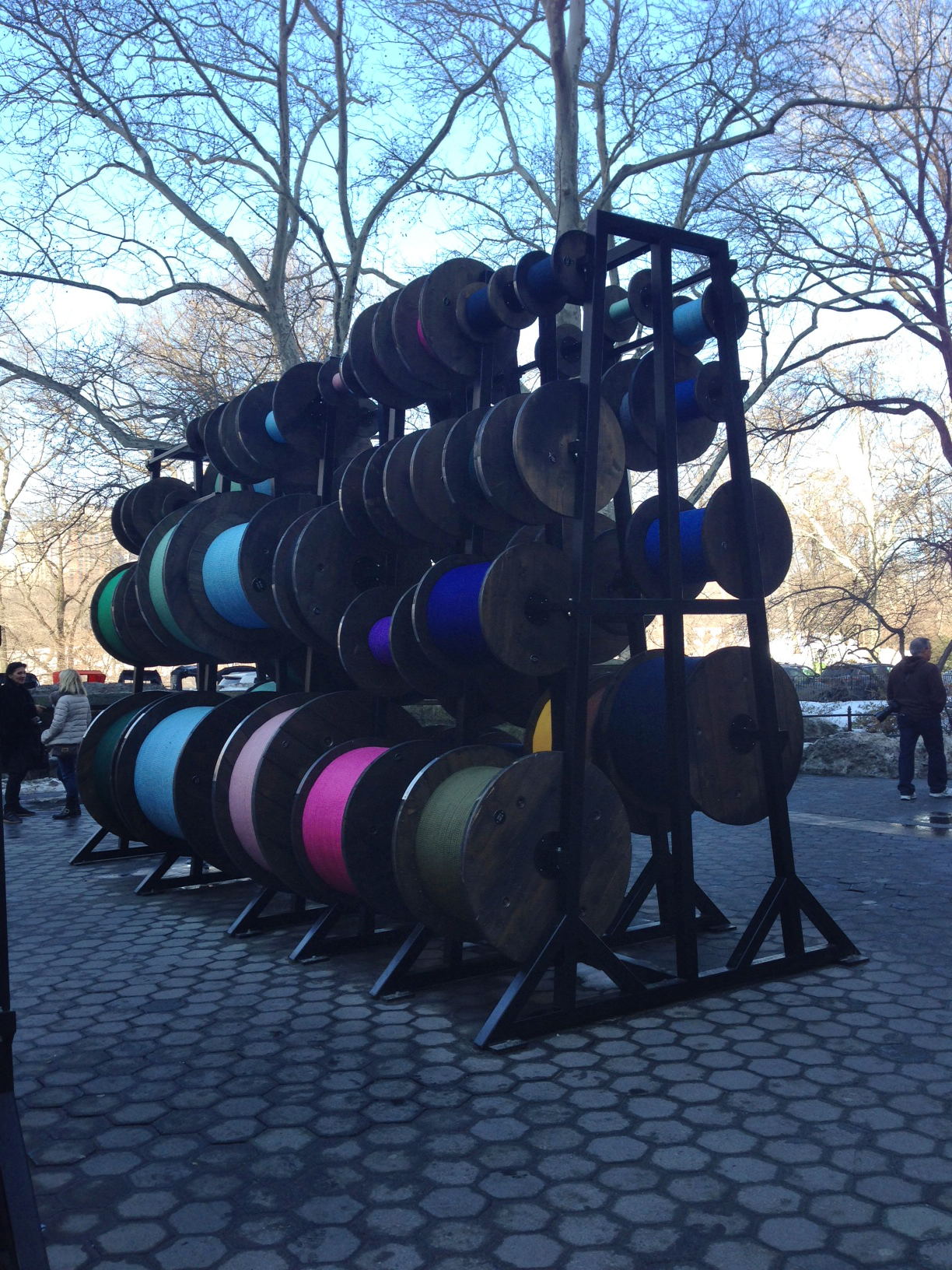
With spring finally in the air, take advantage of the warmer weather and go see “Desire Lines,” a fun and creative outdoor installation by Parisian sculptor, Tatiana Trouvé. It  is composed of miles of colored rope wound around huge wooden spools that hold them. Commissioned by the Public Art Fund, Trouvé’s work is an homage to Central Park. If unwound, the “threads” would stretch along every inch of the 212 paths that snake through the park’s 843-acre rectangle. Many of the paths are unnamed, so Trouvé  invented an “atlas” of the history and culture of walking.


Visitors to Desire Lines can choose a path by name then undertake the walk it describes. I went to visit the piece on a frosty day, when snow was still piled around the edges of the park. Without any visible signage, it was hard to appreciate just what you were seeing. Fortunately, I had a chance to visit the Park Avenue Gagosian Gallery which has a companion exhibit called, “Tatiana Trouvé: Studies for Desire Lines.

At the gallery you can see  sculptures, drawings, and preparatory studies that Trouvé  used for Desire Lines. In addition to vellum tracings and cast part-objects, there are detailed graphite drawings inlaid with copper and vertical maps of Central Park in raw canvas with paths hand-stitched in colored silks.

Tatiana Trouvé at the Gagosian gallery

Tatiana Trouvé at the Gagosian gallery

You can see the sculpture at the Doris C. Freedman Plaza near 60th Street and Fifth Avenue until August 3oth. “Studies for Desire Lines” will be on view until April 25th.

In The Studio: Two Exhibits at Gagosian


“In The Studio” is a pair of exhibitions, at different Gagosian galleries, that focus on images of artists’ studios. The exhibit in Chelsea,“In the Studio: Paintings,” was curated by John Elderfield, Chief Curator Emeritus of Painting and Sculpture at The Museum of Modern Art.

The works span from the mid-sixteenth through the late twentieth centuries. There are over 50 paintings and works on paper by nearly 40 artists including: Georges Braque, Helen Frankenthaler, Alberto Giacometti, Jasper Johns, Henri Matisse, Robert Motherwell, Pablo Picasso, Robert Rauschenberg, and  Diego Rivera. Seeing this art in the gallery setting was a particularly thrilling experience. It was interesting to see the diversity of approaches to a common subject from such influential artists. And the gallery setting provided a much more intimate engagement with the pieces then one would have had in a museum.

The second exhibit, “In the Studio: Photographs,” is on view at the Gagosian Madison Avenue gallery. It includes over 150 photographs, spanning from the beginnings of photography to the late twentieth century.  Forty artists are represented, including: Richard Avedon, Walker Evans  Lee Friedlander, Lucas Samaras and Cindy Sherman. It was curated by Peter Galassi, former Chief Curator of Photography at The Museum of Modern. While I enjoyed the paintings more, the photographs on view are intriguing because of the unique approaches taken by the artists.

Both shows closed April 18th.

Toulouse-Lautrec at MOMA

Henri de Toulouse-Lautrec (French, 1864–1901). Jane Avril. 1899. Lithograph, sheet: 22 1/16 x 15″

Henri de Toulouse-Lautrec (French, 1864–1901). Jane Avril. 1899. Lithograph, sheet: 22 1/16 x 15″

If you went to MoMA in the past few months, it was probably to see the Matisse Cut-Outs exhibit which recently closed. But there’s reason to return soon, and that’s to see “The Paris of Toulouse-Lautrec:Prints and Posters.” The exhibition is drawn almost exclusively from MoMA’s posters, lithographs, printed ephemera, and illustrated books by Lautrec.  It features over 100 examples of the best-known works created during the peak of his career.

 The exhibition is organized around five subjects that create a portrait of Lautrec’s Paris. One section is devoted to café-concerts and dance halls, including  the Moulin Rouge. Another group focuses on the actresses, singers, dancers, and performers who “sparked the artist’s imagination and served as his muses,” according to the exhibition notes.  There’s also a series of prints and posters focusing on prostitutes in their non-working hours. A fourth section is centered on Lautrec’s role in the Parisian artistic community. A final grouping shows Lautrec’s depictions of popular Parisian activities like horse racing at Longchamp and promenading on the Bois de Boulogne.

I was quite familiar with Lautrec’s dance hall posters but found that the simple lines of some of the lesser known works, really drew me in. The exhibit is on view through March 22nd.

From Hebrew Illumination to Contemporary Drawings: Two Exciting Exhibits at the Morgan

What I love about visiting The Morgan Library & Museum are their diverse exhibits and the inviting space within which to experience them. Two newly opened exhibits drew me there recently.

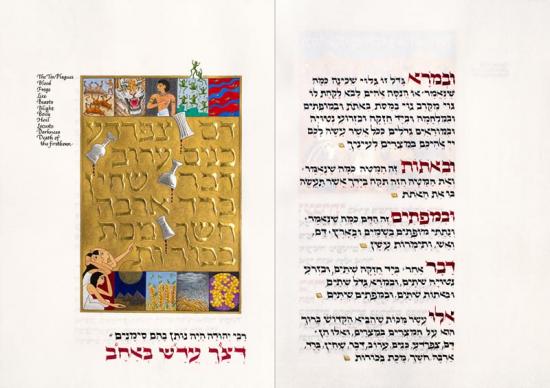
The Ten Plagues, Barbara Wolff The Rose Haggadah 2011–13

The Ten Plagues, Barbara Wolff
The Rose Haggadah
2011–13

The first was “Hebrew Illumination for Our Time: The Art of Barbara Wolff,” (on view until May 3). Wolff is a contemporary artist who uses the techniques of medieval manuscript illumination. She paints on animal skin, and highlights her illustrations with silver, gold, and platinum foils.  The  manuscript, the traditional book that accompanies the Passover Seder, was originally commissioned for use by the Rose family.  The Hebrew text was written by Izzy Pludwinski , and the English captions are by Karen Gorst.

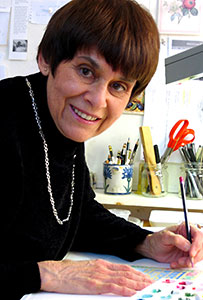
Barbara Wolff

Barbara Wolff

In addition to having each page of the Haggadah on view, there is a fascinating film that accompanies the exhibit. An Illuminated Haggadah for the 21st Century  documents the process and craft involved in creating the Rose Haggadah. Wolf describes everything from what kind of animal skin she selects and why; her formula for creating gesso (the binder applied as a basis for the gold leaf); and the ancient art that inspires her illustrations.

The exhibit also showcases ten folios of “You Renew the Face of the Earth”  which Wolff created to illustrate passages from Hebrew Psalm 104, a celebration of all creation.

This slideshow requires JavaScript.

For a completely different kind of art, also go see Embracing Modernism: Ten Years of Drawings Acquisitions. There are over eighty drawings from 1900-2013, acquired by the Morgan over the past decade. They include an exciting group of artists from Matisse, Mondrian and Schiele to Pollack, Warhol and Lichentstein.  Curator Isabelle Dervaux has organized the drawings “by the characteristics that define its modernity in relation to the historical tradition. ”  The themes are: The Autonomy of the Line; Gesture and Trace; High and Low; Everyday Objects; and From Melancholia to Schizophrenia. This exhibit is on view until May 24th.