Museum

Marisol’s “Self-Portrait Looking at The Last Supper”

marisol

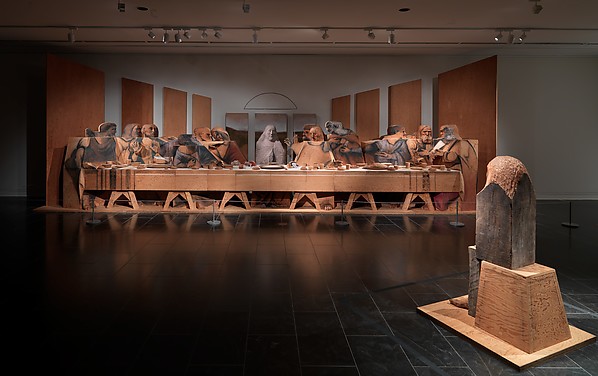
Though I’m at the Metropolitan Museum of Art every week, I somehow missed seeing an incredible sculptural installation by the artist, Marisol.  She is best known for her large figural sculptures, which address a variety of subjects. The piece at the Met is entitled, “Self Portrait Looking at the Last Supper,” and is based on Leonardo Da Vinci’s painting of the same name. At 30-feet long, it is the same length as Da Vinci’s fresco.

Seated across the room from The Last Supper, there is a single wooden figure representing the artist herself . Her presence is meant to underscore that art is about looking, evaluating, and reinventing what one sees, according to the exhibition notes.

You can find “Self Portrait Looking at the Last Supper” all on it’s own in gallery 909 in the first floor Modern and Contemporary Paintings section. Exhibiting it this way allows the viewer to really appreciate the details of the construction and feel the impact of the piece.

“Self Portrait Looking at the Last Supper” was supposed to close several weeks ago but will be on view at least through March. It’s worth a visit to the Met just to see it but certainly stop by if you’re at the Met for other reasons.


One-Year Free Membership To NYC Museums

city id

Cost may be a barrier to an art museum membership. But now there’s an opportunity to get a one-year free membership to the Metropolitan Museum of Art, The Brooklyn Museum, The Studio Museum of Harlem, El Museo del Barrio, MoMa/PS1 and 28 other New York City cultural institutions.

The New York City Municipal ID, launching this month, will give all ID card holders access to one-year free membership packages at some of the City’s leading cultural institutions. The one-year membership will be comparable to each institution’s standard one-year individual or family membership package, depending on the institution. It will give ID card holders a range of benefits including free admission, and access to special events, and discounts to museum shops.

There has been a rush in applications for the ID causing long waiting times for appointments. However, if you don’t need the ID right away, wait a few weeks, and then apply in order to get your museum membership. The “year” begins when you get the card.

The 33 institutions participating in this effort belong to the Cultural Institutions Group (CIG) which is comprised of private nonprofit cultural organizations located on City owned property. Check for specific benefits per institution. See below for a complete list of participating institutions:

Bronx
1. Bronx County Historical Society
2. Bronx Museum of the Arts
3. New York Botanical Garden
4. Wave Hill
5. Wildlife Conservation Society (includes Bronx Zoo, New York Aquarium, Central Park Zoo, Queens Zoo, and Prospect Park Zoo)

Brooklyn
6. Brooklyn Academy of Music
7. Brooklyn Botanic Garden
8. Brooklyn Children’s Museum
9. Brooklyn Museum

Manhattan
10. American Museum of Natural History
11. Carnegie Hall
12. New York City Ballet
13. El Museo del Barrio
14. Lincoln Center for the Performing Arts, Inc.
15. Metropolitan Museum of Art
16. Museum of Jewish Heritage
17. Museum of the City of New York
18. New York City Center
19. Public Theater/New York Shakespeare Festival
20. Studio Museum in Harlem

Queens
21. Flushing Town Hall
22. Jamaica Center for Arts & Learning
23. Museum of the Moving Image
24. New York Hall of Science
25. MoMA PS1
26. Queens Botanical Garden
27. Queens Museum
28. Queens Theatre

Staten Island
29. Snug Harbor Cultural Center & Botanical Garden
30. Staten Island Children’s Museum
31. Staten Island Historical Society
32. Staten Island Museum
33. Staten Island Zoological Society
Wearable Art From Multiple Cultures


This slideshow requires JavaScript.

Exhibits at three different museums showcase wearable art from diverse cultures and demonstrate that there’s more to jewelry than simply adornment.


"Holocaust" neck piece, Joyce J. Scott (2013)

“Holocaust” neck piece, Joyce J. Scott (2013)

Neckpieces and blown glass sculptures by Joyce J. Scott is the focus of a thought-provoking exhibit at the Museum of Art and Design (MAD). Entitled “Maryland to Murano,” the exhibition is the first “to examine the relationship between Scott’s beaded and constructed neck pieces created in her Baltimore, Maryland studio and her more recent blown glass sculptures crafted in the Brenego Studio on Murano Island in Venice, Italy,” according to MAD. The exhibit is on view through March 15, 2015.

Bracelet, Raymond C. Yazzie, 2005. Silver inlaid with coral, turquoise, lapis lazuli, 14-karat gold accents.

Glittering World: Navajo Jewlery of the Yazzie Family features almost 300 examples of contemporary jewelry made by members of one Gallup, New Mexico family.  The works on view at the National Museum of the American Indian are silver, gold, and stone inlay work,  combining bead and stonework as well as silver and gold.  The exhibition, states the museum, “places Navajo jewelry making within its historical context of art and commerce, illustrates its development as a form of cultural expression, and explores the meanings behind its symbolism.” The exhibit is on view through January 2016.

Pair of Anklets, Gold, set with white sapphires, with attached pearls and hanging glass beads; enamel on reverse (1800–50), Al-Thani collection

Pair of Gold Anklets (1800–50), Al-Thani collection

Finally, at the Metropolitan Museum of Art, is  Treasures from India: Jewels from the Al-Thani Collection. Though a smaller exhibit, the sixty items on display here showcase the intricate and colorful styles of the jeweled arts in India from the Mughal period until the present day. They all come from the private collection formed by Sheikh Hamad bin Abdullah Al-Thani. The exhibit will be open until January 25, 2015.

20th Century American Life Captured in Art


This slideshow requires JavaScript.

American life in the 20th century are beautifully captured in exhibitions at two New York City museums: The Metropolitan Museum of Art and the Museum of the City of New York.

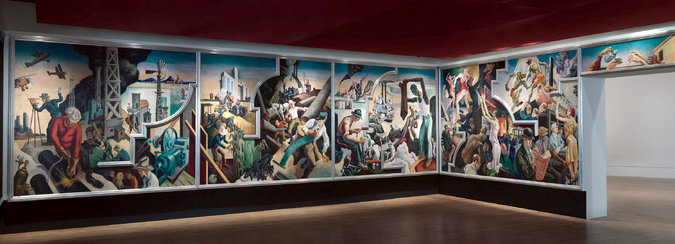
America Today by Thomas Hart Benton, on display at the Met

America Today by Thomas Hart Benton, on display at the Met

America Today, at the Metis a ten-panel mural painted by Thomas Hart Benton in the late 1920’s before his career really took off.  The murals are hung in one large gallery in the American Wing at the museum, replicating how they appeared when they were first hung in the boardroom of New York’s New School for Social Research. The impact of standing in the room, and having an almost panoramic view of these paintings, is spectacular. Each panel vividly brings to life scenes from America in the 1920’s. In an adjacent gallery, you can see sketches and early paintings Benton did to prepare for the murals. I enjoyed seeing these, almost as much as the panels themselves, because you could see how Benton composed many of the scenes. There’s also a room with other works from the Met’s permanent collection that relate to America Today. It was interesting to learn that Jackson Pollack (one painting on view) had been a student of Benton’s and served as a model for his teacher’s mural. This exhibit is on view through April 19, 2015.

This slideshow requires JavaScript.

Mac Conner: A New York Life, at the Museum of the City of New York, is the first exhibition of illustrator McCauley Conner. It contains more than 70 original artworks depicting American life from the 1940’s-1960’s. Conner, a New York native, was an original “Mad Men,” as much of his work was done for advertising agencies. Many of the pieces on view are editorial illustrations, bringing to life, stories that appeared in magazines like Good Housekeeping and Redbook.  I was particularly drawn to the sparse line drawings, with limited colors, that captured a moment in time. For more information on Conner, read an MCNY blog post Mac Conner, One of New York’s Original ‘Mad Men.’  The exhibit is open through January 19, 2015.

The Bronx Museum of the Arts

museum1

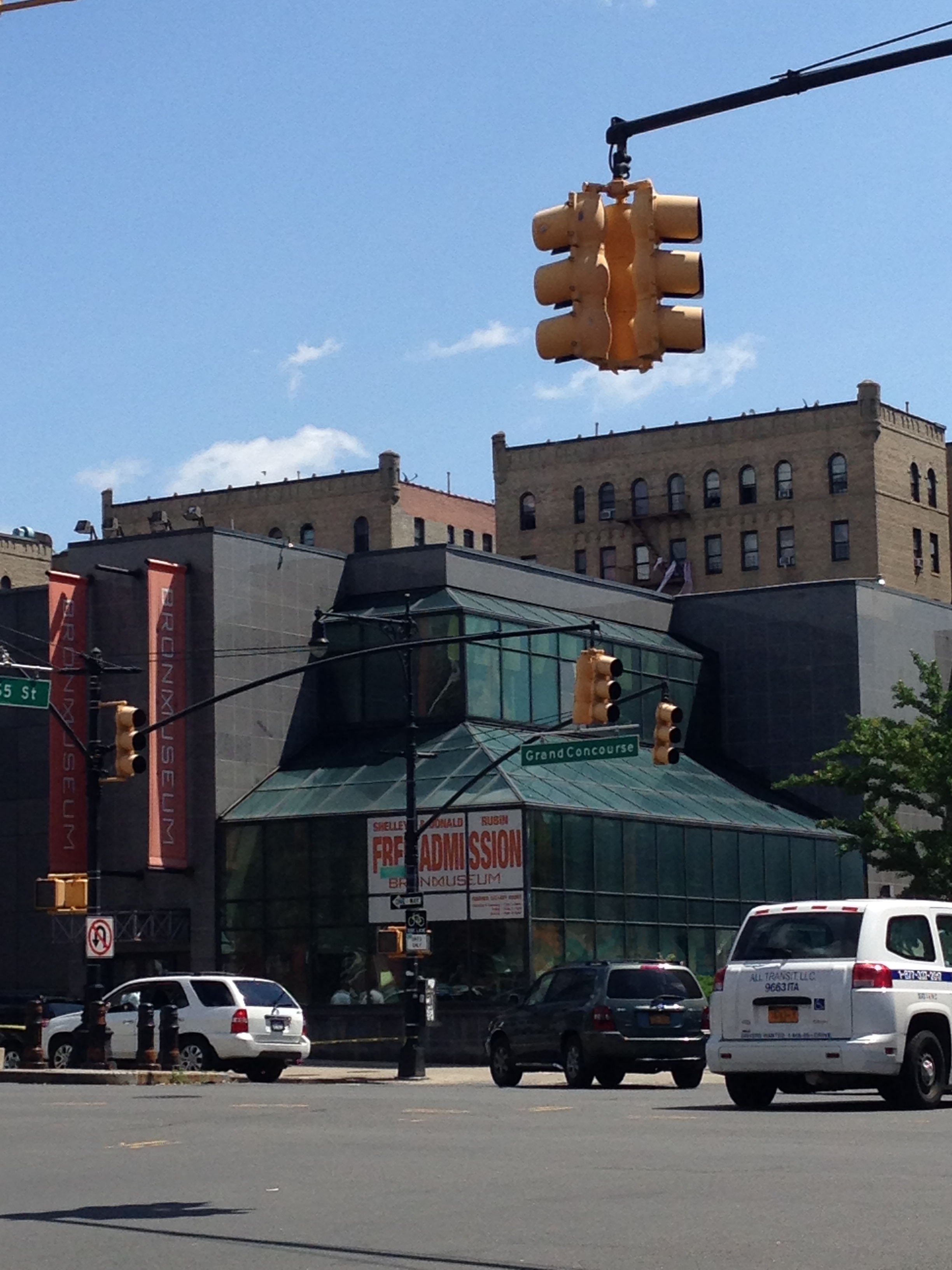
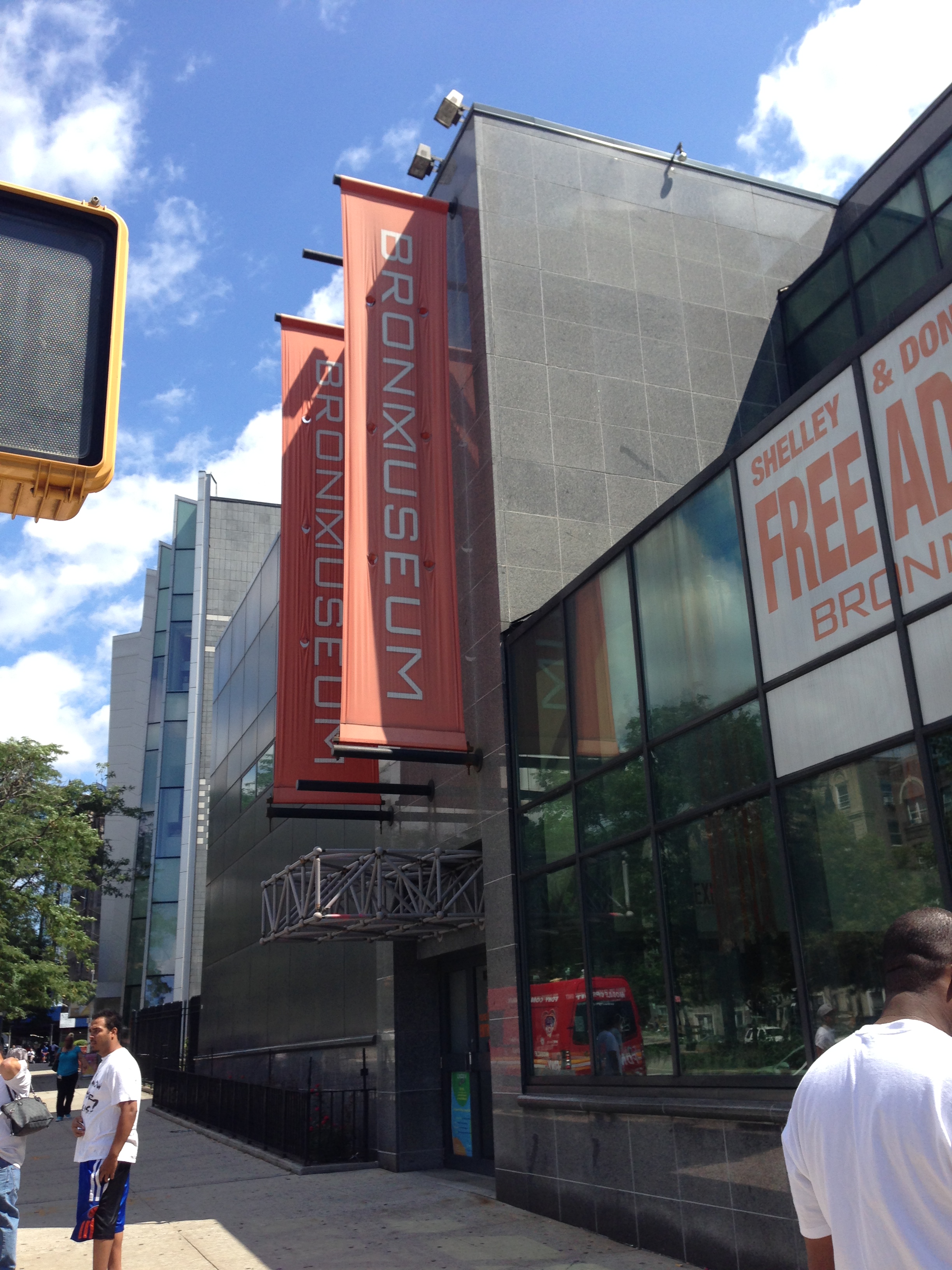
The county courthouse still looms over 161st street, but the Yankees have a new home; the corner candy store is a Burger King; and the synagogue I went to as a kid is now a museum.  While change can be hard, it was more than made up for by my visit to the Bronx Museum of the Arts. Located at 165th street and the Grand Concourse, at the site of the former Young Israel of the Grand Concourse, the Bronx Museum offers an eclectic collection of artworks.

museum

The museum was founded in 1971 and is a contemporary art museum that “connects diverse audiences to the urban experience through its permanent collection, special exhibitions, and education programs.”  There were several interesting exhibits on view when I was there, including a large scale installation by Sarah Sze called “Triple Point (Planetarium),” recently reviewed in the New York Times.

This slideshow requires JavaScript.

I really enjoyed  a charming exhibit on the museum’s terrace called “One Kind of Behavior.” The installation, by Taiwanese artist Shyu Ruey-Shiann, consists of overturned buckets mechanically opening and shutting in response to the wind. The installation, according to the museum, was inspired by the quasi-mechanical movements of creatures such as the hermit crabs. “The artist sees in the random opening and closing of their shells on the beach, a stark contrast with contemporary society where things move at high speed.” This exhibit closed August 17th. But several others are still on view.

This slideshow requires JavaScript.

“Portraits of Veterans”  is a series of colorful paintings by Nina Talbot based on interviews she conducted with men and women from the U.S. Military. The ten paintings in the show, displayed in a bright gallery overlooking the street, focus primarily on Bronx residents and  is on view until August 24th.

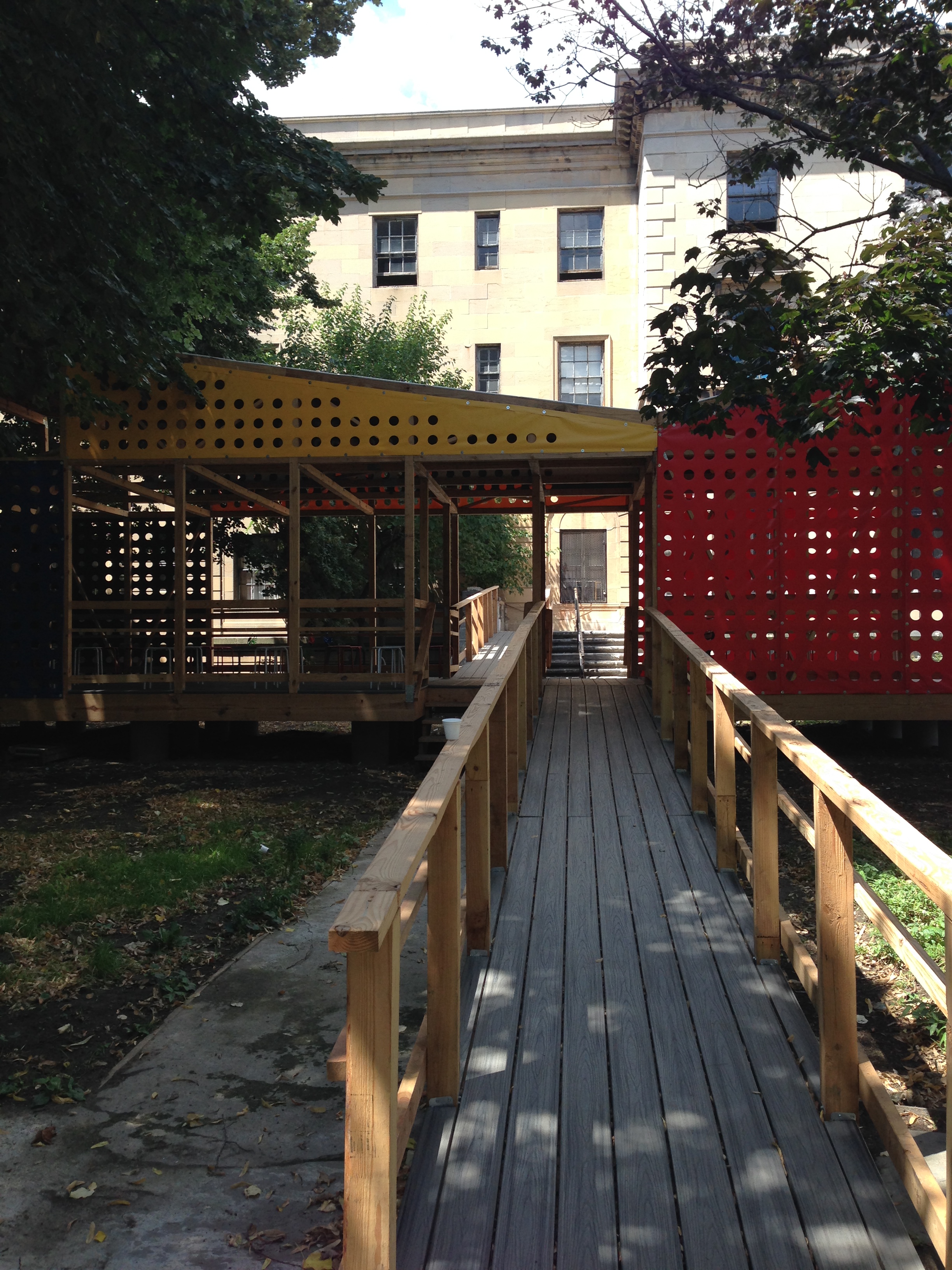
SuperPuesto : temporary pavilion by Terence Gower

SuperPuesto : temporary pavilion by Terence Gower

Diagonally across the street from the museum is “SuperPuesto,” a temporary pavilion by Terence Gower.  The pavilion is part of an exhibition at the Museum entitled “Beyond the Supersquare.” It’s the first U.S. museum exhibition to examine “the complicated legacies of modernist architecture in Latin America and the Caribbean through the perspectives of 30 contemporary artists.”  The pavilion is housed on the grounds of the beautiful Andrew Freedman Home, a “Renaissance Palazzo.”  It served as a home for the elderly for 59 years where “couples and seniors lived out their twilight years in delightful charm and elegance.”  Today, with landmark status, it is undergoing it’s own renaissance and is “expanding into a new and exciting destination for art, culture, learning and creativity.”

SuperPuesto will be on view until November 16.

The Studio Museum In Harlem


studio

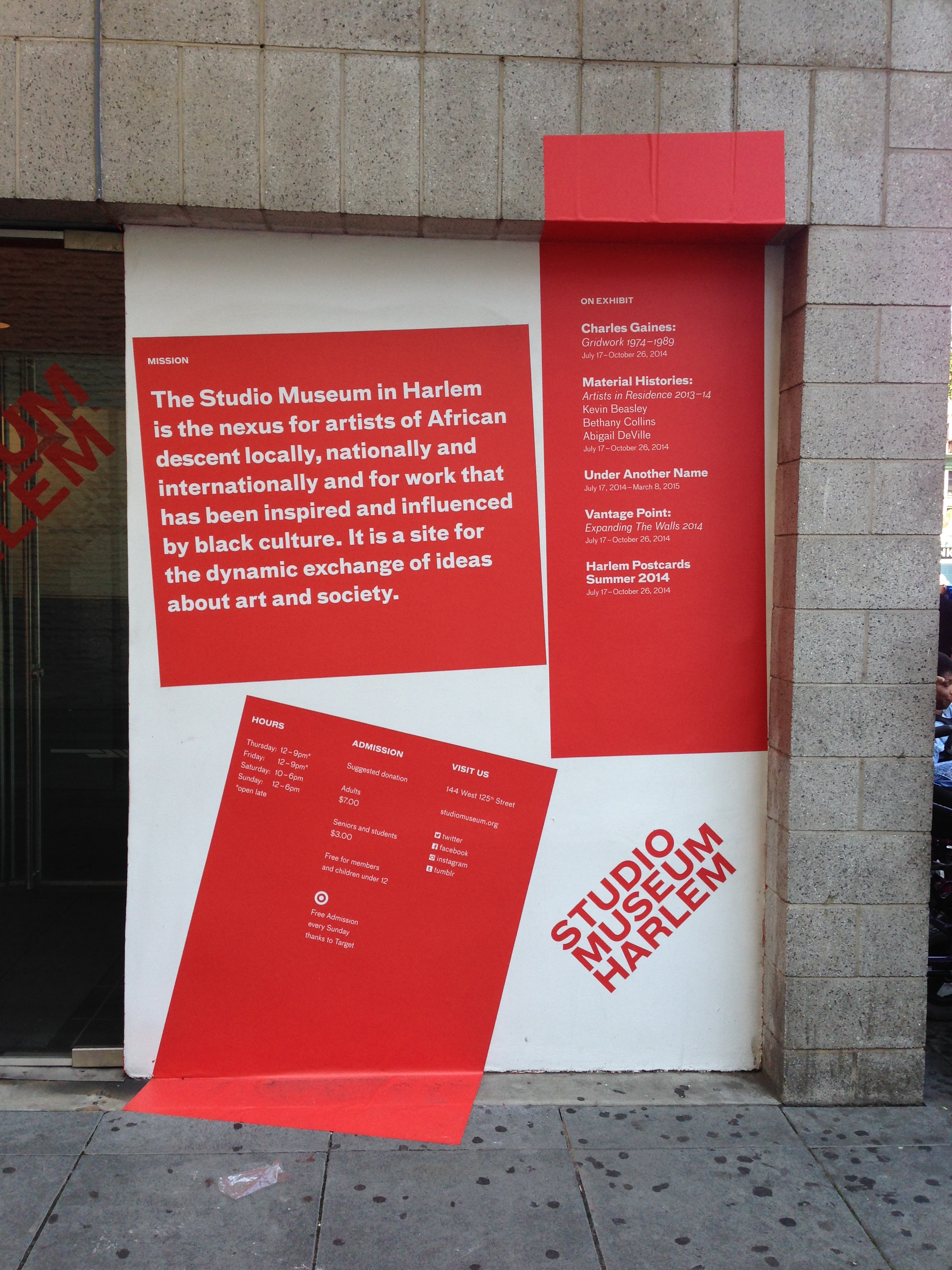
If you weren’t looking for it you would probably pass it by. But the Studio Museum in Harlem is worth seeking out. Founded in 1968 and located on west 125th street, The Studio Museum showcases work from artists of “African descent locally, nationally and internationally,” as well as work that has been inspired and influenced by black culture. The museum’s permanent collection  “represents more than 400 artists, spans 200 years of history and includes over 1,700 works of art, including paintings, drawings, sculptures, watercolors, photographs, videos and mixed-media installations. ”

Albert Vecerka Untitled (from “The Harlem Project” series), 2014

Albert Vecerka
Untitled (from “The Harlem Project” series), 2014

Art work from the ongoing “Harlem Postcards” Project is the first thing you’ll see, even before entering the galleries. The Project invites contemporary artists of varied backgrounds to capture the diversity and vitality of Harlem, culturally or politically Each photograph is reproduced as a limited edition postcard and available free to visitors.

This slideshow requires JavaScript.

What I really love about the museum is that the gallery space is bright and broad, and the art work is very accessible.  And though the museum is small, there is usually 1 large exhibit and 1-2 smaller exhibits on view. Recently opened is  “Charles Gaines: Gridwork 1974-1989. Gaines is a Los Angeles based conceptual artist and is celebrated  for his photographs, drawings and works on paper that “investigate systems, cognition and language.” I was particularly taken by the “Numbers and Trees” series; both the individual paintings and the collection viewed as as whole. What I learned at the exhibit was that Gaines often began these works with an arbitrarily selected arithmetic formula. He then used the formula to generate shapes plotted on a grid. As you view each painting you can see how these grids progressed.

Bethany Collins: Southern Review, 1987, 2014

Bethany Collins: Southern Review, 1987, 2014

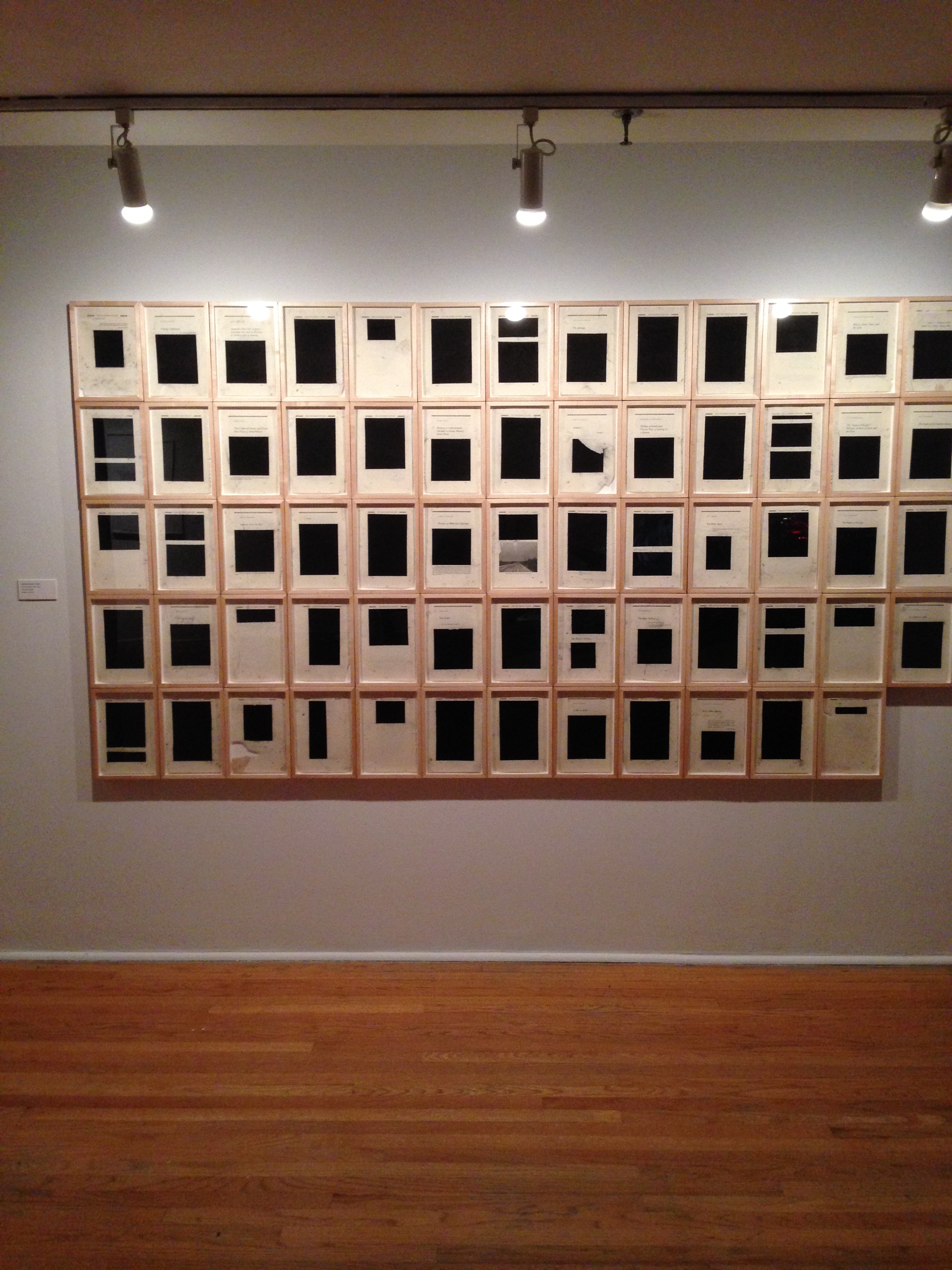
“Material Histories: Artists In Residence 2013-14″ is another special exhibit featuring the works of three young artists, Kevin Beasley, Bethany Collins and Abigail DeVille. They were all awarded an eleven-month residency at the Studio Museum as part of the Museum’s commitment to support emerging artists. I really liked the work of Ms. Collins. ArtsATL.com describes Collins as “a conceptual artist who makes alluring paintings. She parses, decodes and deconstructs language and then deploys sentences, words and letters as visual vocabulary.” In one piece, Collins taped pages of the 1993 edition of Southern Review to the wall and blacked out the text, creating rectangular blocks. Up close you can see what was blackened, but from afar the pieces work together to create an engaging abstract visual.

Both these exhibits will be on view until October 26.

Peabody Essex Museum — An Art Find Outside of New York

peabody

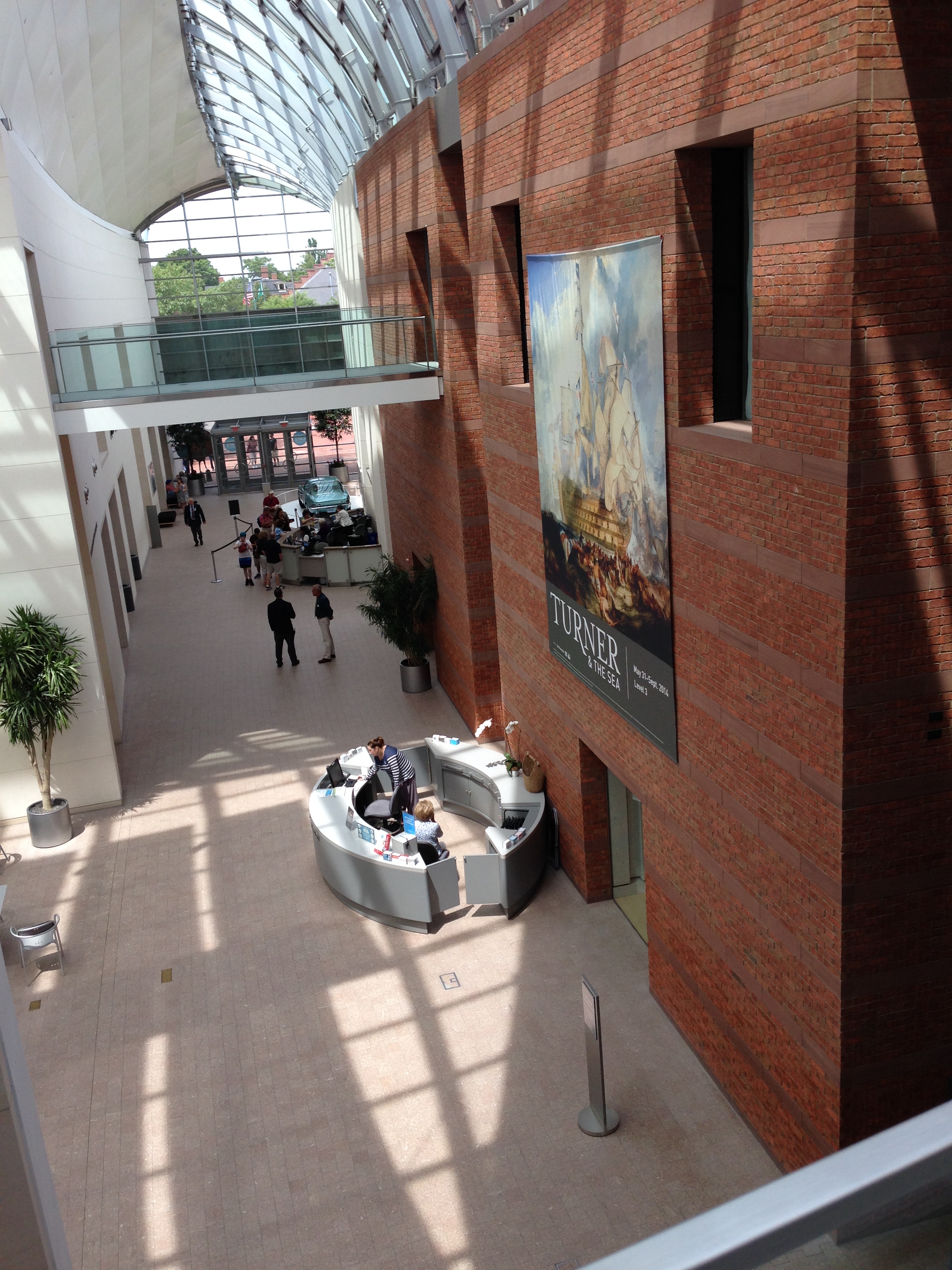
The atrium lobby of the Peabody Essex Museum

Summer is a time for both “staycations” and vacations. When I’m on vacation I try to check out local museums and historical sites. Just recently, I spent the day in Salem, MA.  The reason for the visit was to see the House of the Seven Gables, that inspired the Nathaniel Hawthorne book of the same name. But while I was there, I had the surprising pleasure of getting to know a wonderful art museum, called the Peabody Essex Museum.

Putnam Family Cupboard, 1680

Putnam Family Cupboard, 1680

Founded in 1799, the Peabody Essex Museum  is one of the nation’s major museums for Asian art, including Japanese, Chinese, Korean and Indian art, along with a collection of Asian Export art extant and 19th-century Asian photography. It has the earliest collections of Native American and Oceanic art in the nation.  Their American Collection includes historic houses and gardens, and American decorative art and maritime art collections spanning 300 years of New England’s heritage.

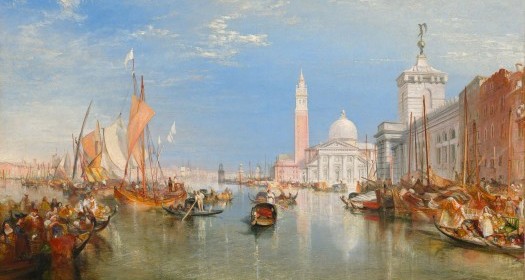
JMW Turner, Venice: The Dogana and San Giorgio Maggiore

JMW Turner, Venice: The Dogana and San Giorgio Maggiore

In addition to the PEM permanent collection, they also have special exhibitions like the current one, Turner & the Sea, on view until September 1st. Throughout multiple gallery rooms, you see the breadth and depth of Joseph Mallord William Turner’s lifelong preoccupation with the sea. It includes his Academy paintings of the late 1790s and early 1800s, to the unfinished, experimental seascapes produced towards the end of his life.

If you are ever visiting Boston or traveling North of there, make a stop in Salem and visit the Peabody Essex Museum.

Museum of Biblical Art: A Contemporary Look at the Old

frontWhile the New York Times beat me to the story about their current exhibit, the Museum of Biblical Art, a free art museum known as MOBIA,  is still worth noting. Founded in 2005, MOBIA is located on Broadway and 61st Street in the same building as the American Bible Society. But it is an independent museum, i.e., not affiliated with a particular religious group. It’s mission is to “engage diverse audiences in the exploration of great works of art inspired by the Bible.”
eden

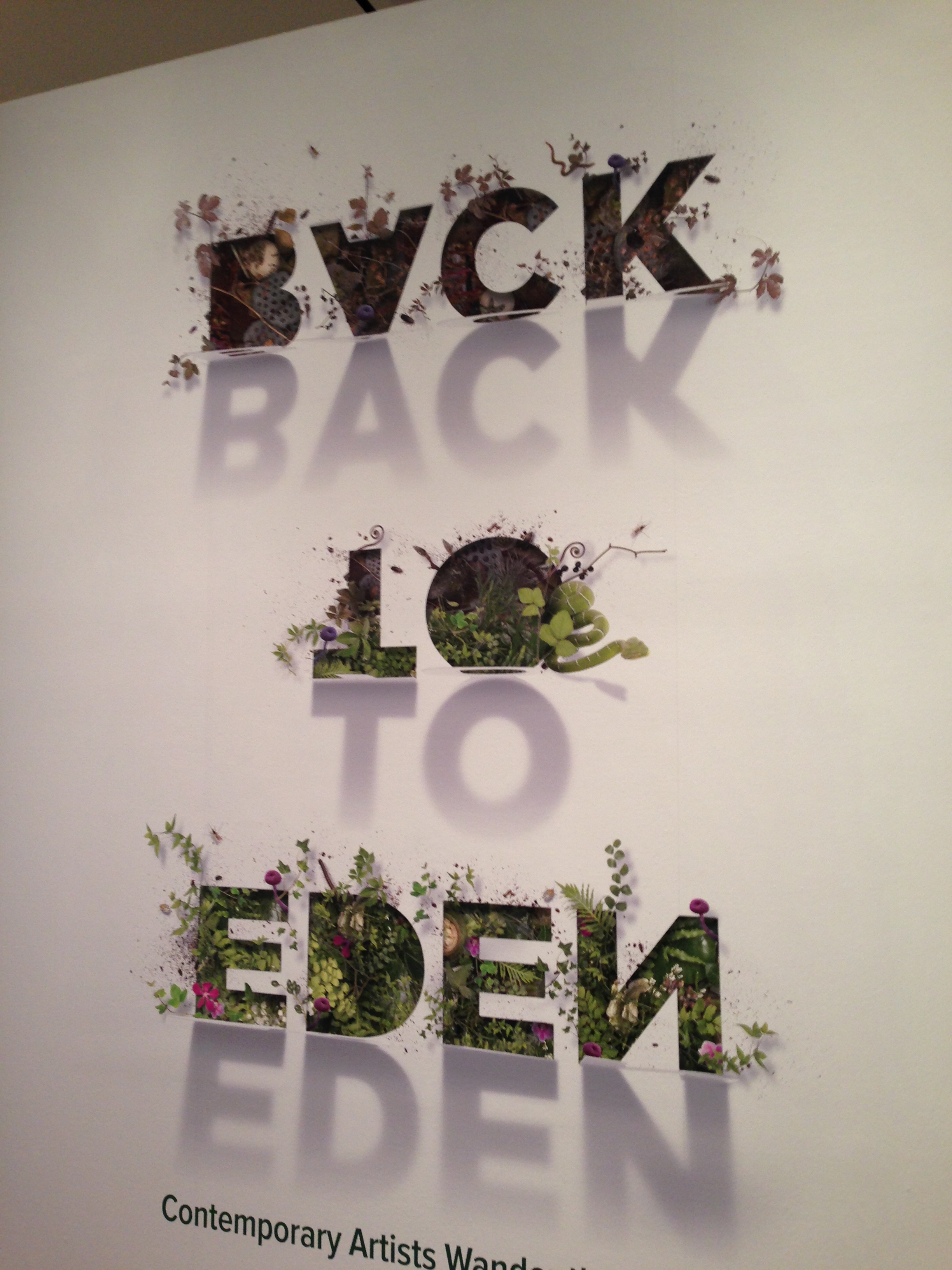
MOBIA is relatively small, with no permanent collection, so the focus is on one special exhibition at a time. On view until September 28 is Back to Eden: Contemporary Artists Wander the Garden. The exhibition brings together work by a group of about 20 contemporary artists. All the pieces in the show were either directly or indirectly inspired by the story of the Garden of Eden. The art work — painting, sculpture, video, among others —  provide a broad view the relationship between humans and the natural world.

This slideshow requires JavaScript.

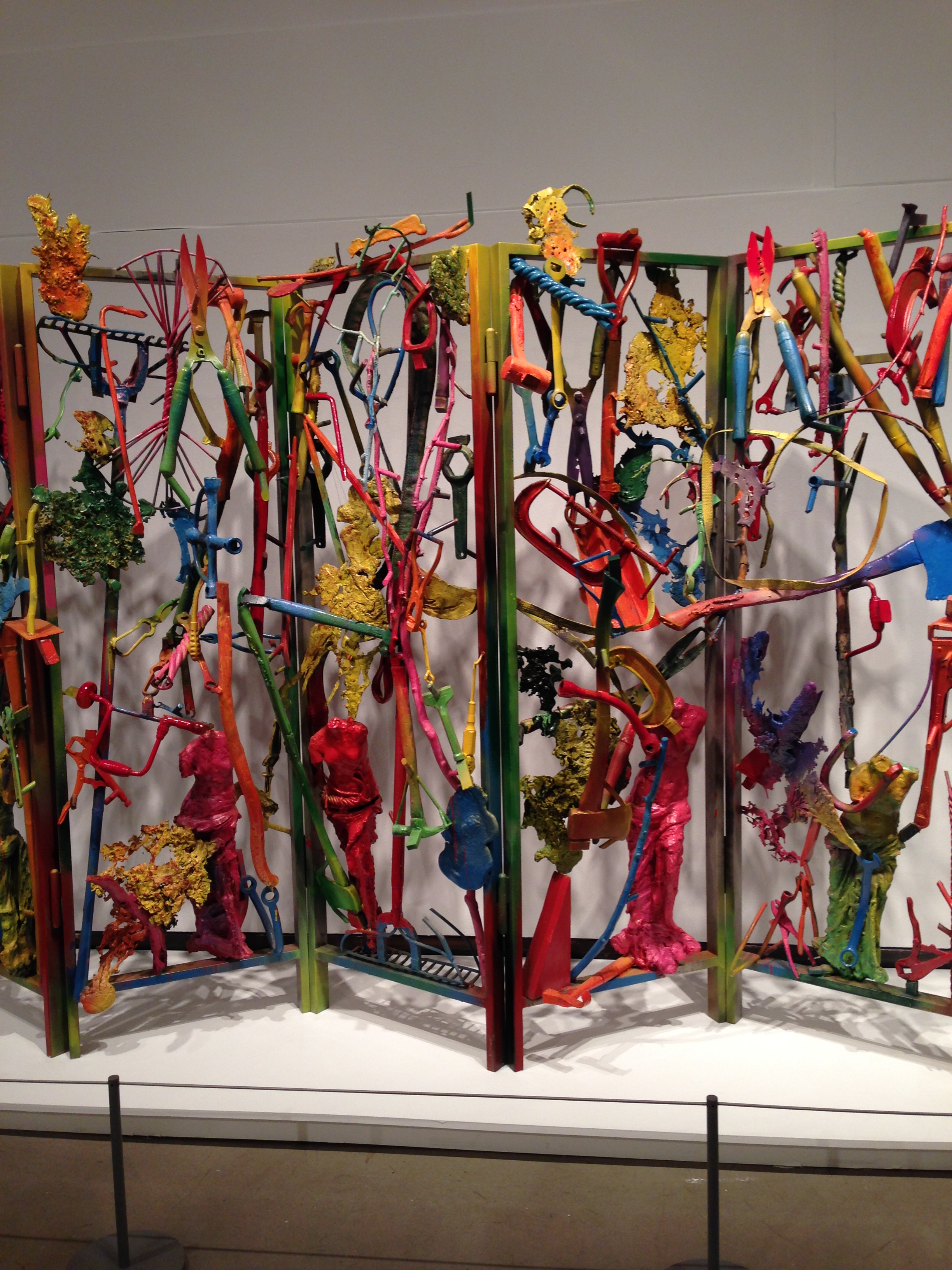
There were two pieces that stood out for me. The first (above) was an HD video projection called “1000 Paths(To The Divine) . The piece is by Sean Capone, a projection artist based in New York City who presents simulated floral vistas, with a focus on pattern and decoration. 1000 Paths (To The Divine) “suggests a continuous cycle of growth, death, and rebirth by immersing the viewer in a morphing virtual garden.” Another piece I really liked (see below) was by Pop Artist, Jime Dine.

The Garden of Eden, Jim Dine (2003)

The Garden of Eden, Jim Dine (2003)


National Academy Museum: “Redefining Tradition”

front

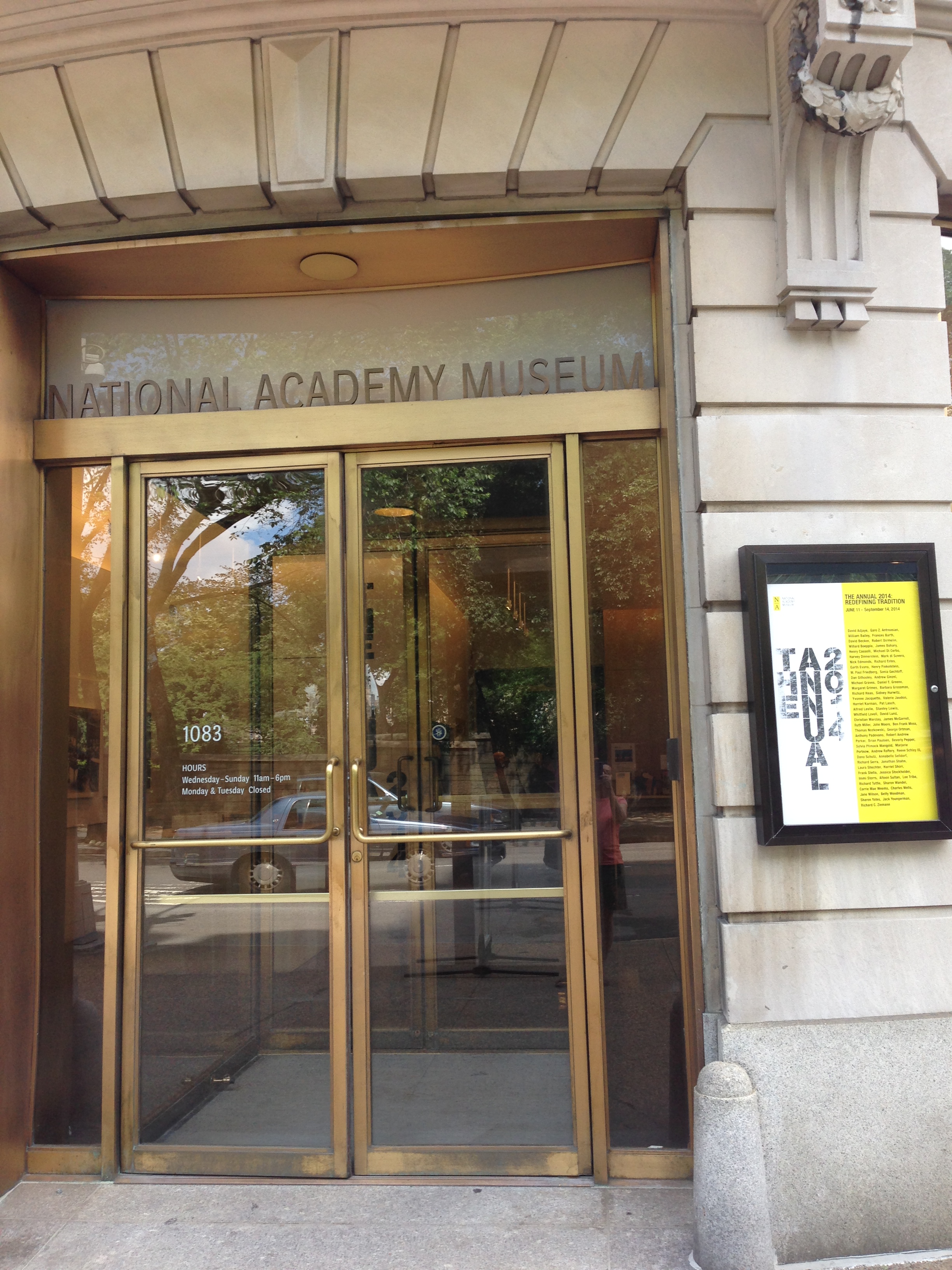
Located on Fifth Avenue, to the north of the Guggenheim and south of the Cooper Hewitt Museum, The National Academy (founded in 1825) is an association of artists and architects; a school; and surprisingly for many people, a museum.

This slideshow requires JavaScript.

Each year the Academy Museum has an exhibit to promote the works of  a selection of their Academicians (over 300 prominent artists and architects). This year’s exhibit – Redefining Tradition – brings together multiple generations of National Academicians and “creates a constellation that illuminates affinities, connections, differences, and most importantly a relevant continuum of American art and architecture, ” according to the Academy. The exhibit includes paintings, drawings, sculpture, and architectural design from more than 60 artists and architects including Richard Serra and Carrie Mae Weems.  As a visitor, I really enjoyed the open  spaces of the exhibit areas, and the opportunity to get to know artists I was unfamiliar with, like Margaret Grimes, Barbara Grossman, and Charles Wells.

Over the year, The Academy Museum offers an eclectic selection of exhibitions. Among those on view this year was a retrospective of paintings by Swedish artist, Anders Zorn (1860-1920); “See It Loud,” seven post-war American painters whose art “grew out of abstract currents, but shifted toward representation;” and an exhibit showcasing prints from the Museum’s collection.

Redefining Traditions will be on view until September 14, 2014.

The Morgan Library and Museum: Much More Than Books


front

The Morgan Library & Museum began as the private library of financier Pierpont Morgan and was built between 1902 and 1906 next to his New York residence at Madison Avenue and 36th Street.  According to the Morgan, it was ” intended as something more than a repository of rare materials … the structure was to reflect the nature and stature of its holdings.”  In 1924, eleven years after Pierpont Morgan’s death, his son, J. P. Morgan, Jr., transformed the library it into a public institution.  Since then the building has expanded both in its physical structure and content, acquiring  rare materials as well as important music manuscripts, early children’s books, Americana, and materials from the twentieth century. The Morgan offers much more than just a vast book collection. It’s also a wonderful place to see art . Between their special exhibits and their permanent collections, there is something for everyone.

This slideshow requires JavaScript.

One exciting exhibit on view now is A Certain Slant of Light: Spencer Finch at the Morgan (through January 11, 2015).  Finch has taken films of color and applied them to the large windows found in the Morgan’s glass-enclosed Gilbert Court; which you see just as you enter the building. His work was inspired by the Morgan’s collection of medieval Books of Hours— hand-painted  personal prayer books for different times of the day and different periods of the year (also on view). To underscore his inspiration, Finch has also hung additional glass panes in the center of the Court. They reflect the colors of the other panels and create a kind of calendar based on the movement of the sun. Nearby, you can see some of the watercolors and sketches Finch created as a first step in the project.

This slideshow requires JavaScript.

To experience a different approach to light and color, visit another exhibition called, “A Dialogue with Nature: Romantic Landscapes from Britain and Germany” (until September 7, 2014). The exhibition includes thirty-seven works from the Morgan’s permanent collections. They represent  “two central elements of the Romantic conception of landscape: close observation of the natural world and the importance of the imagination,” according to the Morgan. One of my favorite painters in the collection was JMW Turner, a British Romantic landscape painter who painted during the first half of the 19th century.  One interesting aspect of his work was Turner’s scrapping, blotting, and wiping away the paint while it was still wet. Then he scratched into or drew on dry surfaces to create various details.

There are several other exhibits now on view at the Morgan and all are worth seeing, including: “Miracles in Miniature: The Art of the Master of Claude de France,” and “Sky Studies: Oil Sketches from the Thaw Collection,” as well as some interesting book collections.